
.webp)
Decentralised Identity & Digital Wallets
Next-Generation Identity with Decentralisation and Intelligence



Understanding the enterprise challenges


Why This Matters
Centralised identity stores are among the most attractive targets in the digital economy: compromise one and millions of identities are exposed simultaneously. Regulatory pressure for data minimisation and user consent is growing under GDPR and equivalent frameworks globally. Governments, regulated industries, and consumer-facing sectors are moving rapidly towards digital credential standards from digital driving licences and passports to professional certifications, event access, and academic qualifications. Organisations that cannot issue, consume, and verify these credentials are already falling behind. At the same time, credential fraud; counterfeit tickets, falsified qualifications, forged identity documents, costs organisations and individuals billions annually, and existing verification processes are too slow, too manual, and too easily circumvented.
What are Verifiable Credentials?
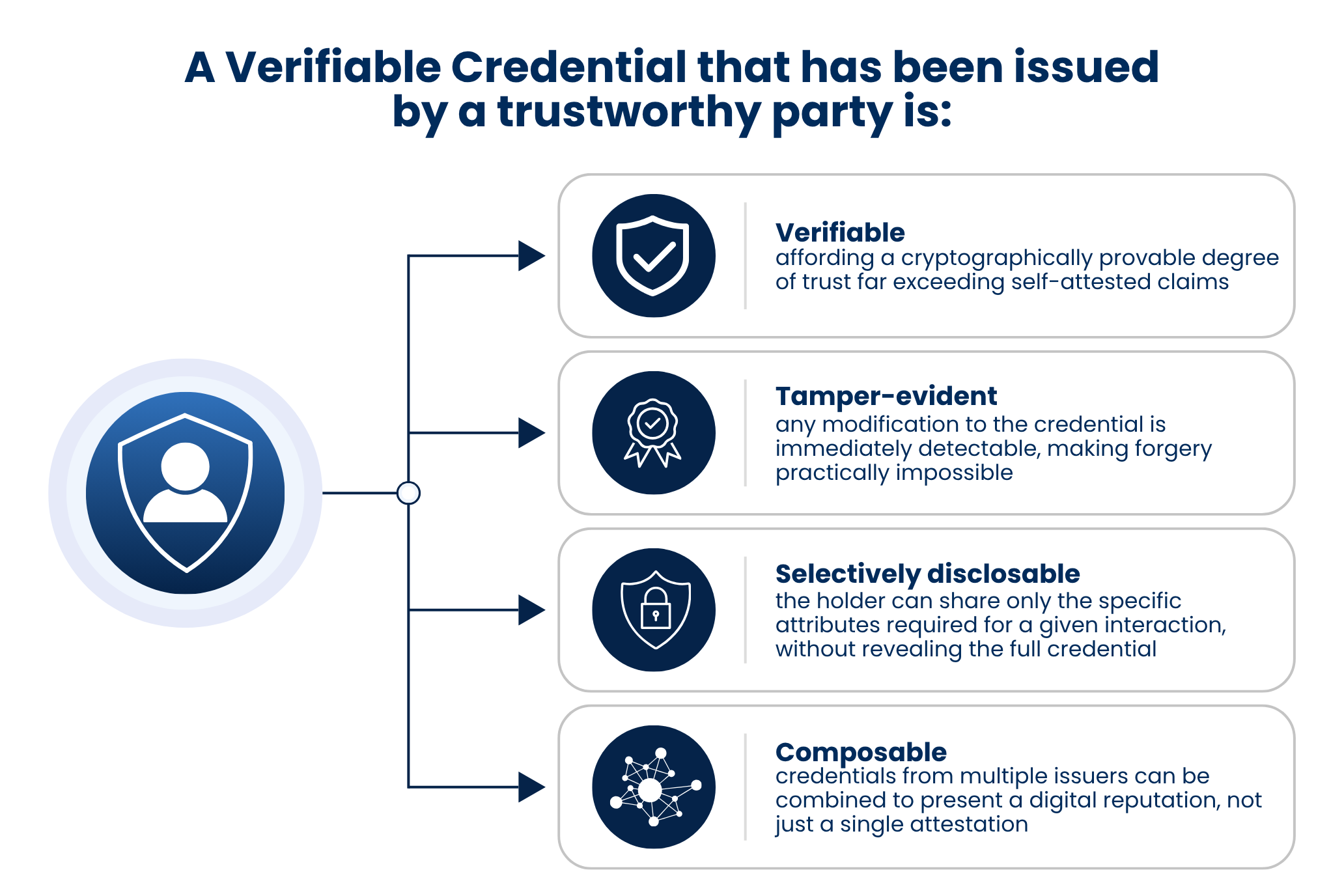
Verifiable Credentials (VCs) are a digital standard from the World Wide Web Consortium (W3C) designed to create a more trustworthy way of holding and presenting identity data. From a technical perspective, a VC is a tamper-evident data file containing a set of claims about a person, organisation, or thing that can be cryptographically verified by any relying party. Unlike traditional credentials — which rely on the issuing authority being directly contactable at the moment of verification, VCs can be verified offline, instantly, and without the holder revealing more information than is strictly required.

The Trevonix Approach
Trevonix implements decentralised identity frameworks using W3C Verifiable Credentials and Decentralised Identifiers (DIDs), combined with secure digital identity wallets that give individuals control over their own credential estate. We design trust registries, issuer and verifier architectures, and credential verification flows that work across public and private sector contexts. Our implementations are standards-based, interoperable, and regulatory-aligned — designed to deliver measurable value today while remaining extensible as the decentralised identity ecosystem matures.
Integrating identity into access control and threat response
.png)
Tamper-Proof, Privacy-Preserving Digital Credentials
- W3C Verifiable Credential implementation enabling cryptographically verifiable digital attestations across any domain
- Selective disclosure allowing individuals to share only the specific attributes required for a given interaction
- Issuer, holder, and verifier architecture supporting any trust relationship across public and private sector contexts
- Credential lifecycle management including issuance, renewal, revocation, and real-time status checking
- Support for government-issued credentials, professional certifications, academic qualifications, event access, and enterprise entitlements
- Interoperability with emerging national and international digital identity frameworks including eIDAS 2.0
.png)
User-Controlled Credential Storage and Presentation
- Secure digital wallet enabling individuals to store, manage, and present verifiable credentials across contexts
- Multi-credential wallet supporting government IDs, professional licences, academic certificates, event tickets, and enterprise access tokens
- Privacy-preserving presentation flows that share only what is required for each verification interaction
- Cross-platform wallet interoperability aligned to EU Digital Identity Wallet and equivalent global standards
.png)
Self-Sovereign Identity Without Central Authority Dependency
- DID method implementation enabling portable, user-controlled identity anchored to distributed or web-based registries
- Trust registry design enabling verifiers to confirm issuer authority without centralised intermediaries
- Reduced dependency on single identity providers and the breach risk they represent
- Architecture designed for interoperability across public sector, regulated industry, and enterprise contexts
Reimagining Ticketing with Verifiable Credentials
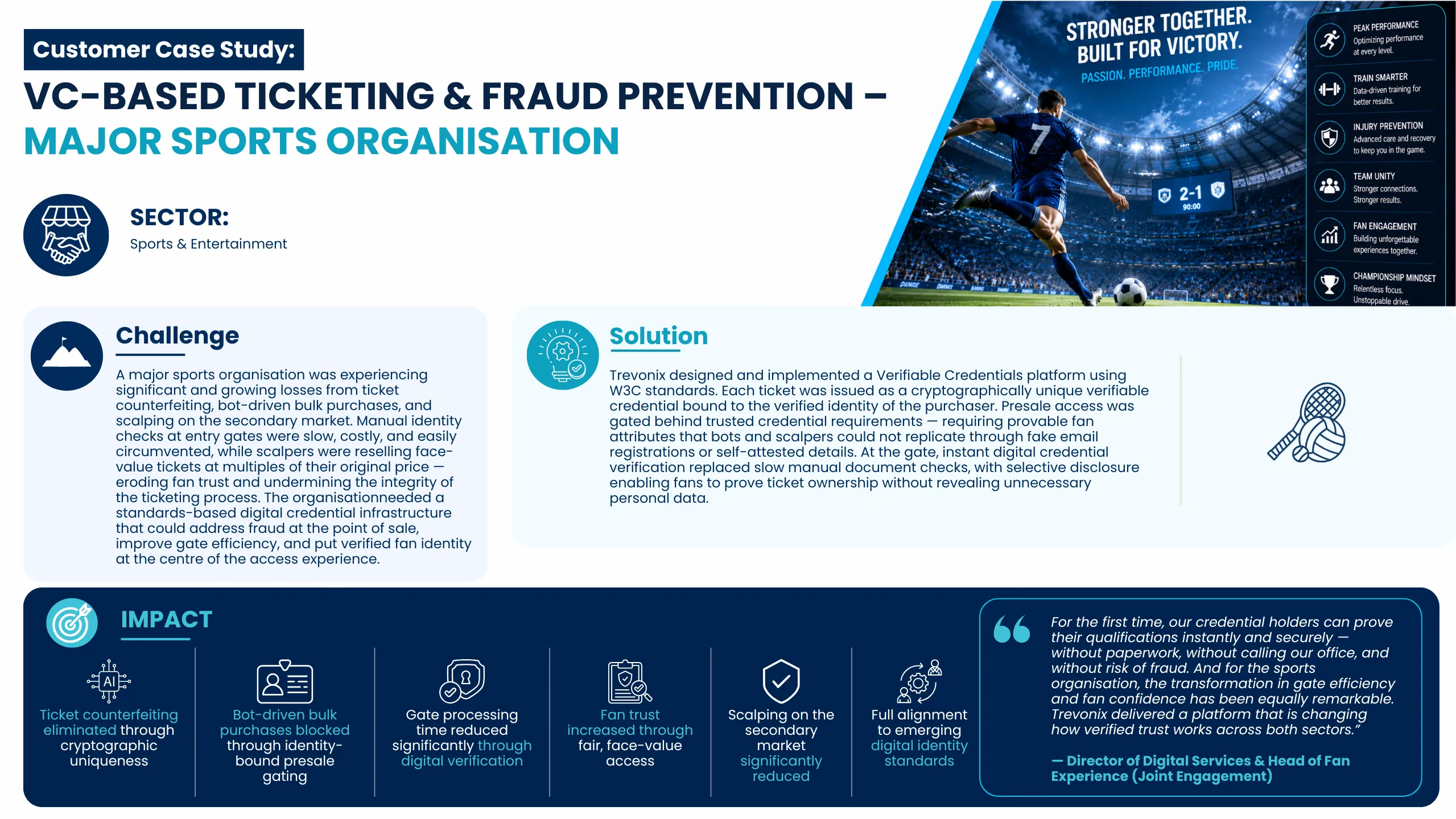
One of the most compelling and immediately practical applications of Verifiable Credentials is in the ticketing and events industry a sector plagued by counterfeiting, scalpers, bots, and inefficient manual identity checks. Trevonix implements VC-based ticketing solutions that address each of these challenges simultaneously, replacing fraud-prone paper and QR-code tickets with cryptographically unique, identity-bound digital credentials.
The problem with traditional ticketing is fundamental: tickets are not bound to identity. Bots and scalpers can acquire tickets in bulk using fake email addresses and self-attested details, because “verified” status in most systems relies on claims the user makes about themselves rather than cryptographically proven attributes. Research has found that bot activity accounts for over 40% of activity in online ticket sales. Meanwhile, at the gate, manual document checks are slow, expensive, and easily circumvented as has been demonstrated repeatedly by individuals accessing high-security events using nothing more than a convincing prop.
With Verifiable Credentials, each ticket is cryptographically unique, bound to the holder’s verified identity, and impossible to replicate without detection. Presale access can be gated behind trusted credential requirements, a fan credential issued by an artist, a credential authenticating with a social platform, or for higher-assurance scenarios, a credential issued by a bank or government authority. Each of these is far harder for bots to replicate than a self-attested email registration, because they require a provable digital reputation rather than a new identifier.
.png)
Benefits of VC-Based Ticketing
Reduced Counterfeiting: Each ticket is cryptographically unique. Fakes are identified immediately at the gate through automated verification, eliminating the manual document checks that bots and fraudsters currently exploit.
Improved Gate Efficiency: Rapid digital validation at entry eliminates long queues and reduces reliance on manual checks by security staff, improving the experience for legitimate attendees and reducing operational cost for organisers.
Fan Privacy: Selective disclosure means fans can prove they hold a valid ticket without revealing sensitive personal information. This is a significant improvement over traditional, data-heavy verification systems that collect far more personal data than the interaction requires.
Fan Trust: When tickets are sold at face value and fraud is minimised, trust in the event organiser and the brand increases. Verified, identity-bound ticketing signals that the organisation takes fan fairness seriously — a meaningful differentiator in a market where scalping has become normalised.

.png)


.png)

.png)
.png)

.png)
.png)
.png)
Why Identity- First Approach
Trevonix
The Others
IAM Strategy & Advisory
Clarifies current identity state and next steps.


Identity Maturity Assessment
Evaluates your current IAM maturity and identifies gaps.
Identity-as-a-Service (IDaaS)
Delivers scalable, cloud-based identity platforms.
Interim IAM Leadership
Provides experienced leadership for IAM programmes.




.avif)

%20(32).png)


%20(33).png)
%20(30).png)
%20(31).png)