

In an era where cyber-threats evolve quickly and enterprise IT environments are more complex than ever, an effective security architecture has never been more critical. Companies are shifting their focus from simply building perimeters to designing architectures that embed security into every layer — across identity, endpoints, networks, applications, data, and the cloud. In this blog we will explore how modern organisations structure their security architecture, starting with the fundamentals, moving through the core concepts of zero-trust and cloud security, and concluding with best practices for building a robust architecture that aligns with today’s threat landscape.
By the end of this article, you’ll have a clearer picture of:
- What security architecture is and why it matters
- How zero trust security architecture is transforming how we protect digital assets
- How cloud security architecture differs from traditional models, and what enterprises must do to secure cloud infrastructure
- How cloud computing security architecture ties into both zero trust and cloud security
- The vital role of privileged access management architecture in enforcing least-privilege and reducing risk
- How to integrate zero trust and cloud security into a unified architecture
- Key best practices you can action today
Let’s begin by understanding the foundation: what we mean by security architecture.
Table of Contents
- What Is Security Architecture?
- Zero Trust Architecture Definition
- Understanding Zero Trust Security Architecture
- Cloud Security Architecture Explained
- Cloud Computing Security Architecture
- Privileged Access Management Architecture
- Integrating Zero Trust and Cloud Security Architectures
- Best Practices for Building a Secure Architecture
- Conclusion
What Is Security Architecture
A clear understanding of security architecture is essential before diving into the specialised domains of zero trust or cloud security.
Definition and Components
Security architecture refers to the structured set of principles, frameworks, models, and practices that guide how an organization secures its information technology assets. It addresses people, process, and technology — the classic triad:
- People: the users, administrators, security teams, risk management teams — essentially all human actors who interact with systems and data.
- Processes: the policies, procedures, governance, change management, incident response, compliance frameworks — how security is operationalised.
- Technology: the tools, products, platforms, network infrastructure, identity management systems, encryption, monitoring and credentialing systems.
By combining these three components, security architecture provides a blueprint for how security is built, maintained and evolved across an organisation.
Why It Matters
Security architecture matters for several reasons:
- It provides a framework to protect an organisation’s IT assets — including data, systems, applications, and infrastructure — in a coherent and repeatable way.
- It helps ensure compliance with regulatory, industry and internal governance requirements (for example data protection laws, audit standards, security certifications).
- It helps organisations align business and security goals — ensuring security isn’t just an afterthought, but built into the design of systems and services.
- It enables consistency and scalability — as enterprises grow, merge, adopt cloud or hybrid models, a well-designed security architecture allows for expansion without chaotic security trade-offs.
- It helps reduce risk — by mapping threat scenarios, identifying vulnerable assets, applying layered defenses and enabling proactive incident response.
In short: as organisations evolve and the threat landscape grows ever more complex, security architecture becomes the foundational discipline that ensures security is systemic, not ad-hoc.
Zero Trust Architecture Definition
Before we dive deeper into zero trust, let’s define it clearly.
Zero trust architecture definition is the design of a security architecture in which no user or system — internal or external — is automatically trusted. Instead, every access request is verified, whether it comes from inside the corporate network or outside. The principle is “never trust, always verify”.
In practical terms, a zero trust architecture is a security architecture that requires strict identity verification for every person and device trying to access resources on a network, regardless of whether they are inside or outside the network perimeter.
Understanding Zero Trust Security Architecture
Now we will examine the architecture built around zero trust — the layers, benefits, and implementation steps.
Layers of Zero Trust Security Architecture
A robust zero trust security architecture touches multiple layers of the infrastructure:
- Identity layer: Verifying the identity of users, devices, services. This includes strong authentication (MFA/2FA), device posture, identity governance, and least-privilege access.
- Endpoint layer: Ensuring that devices (laptops, mobile phones, IoT) comply with security policies (patching, antivirus, configuration, micro‐segmentation) before granting access.
- Network layer: Instead of assuming a trusted network inside the perimeter, zero trust uses segmentation, monitoring, encrypted flows, and least-privilege network access.
- Application layer: Applications enforce access control, session monitoring, runtime protection, and can operate under zero trust assumptions (e.g., assume breach, evaluate every access request).
- Data layer: Data is protected by classification, encryption (at rest/in transit), access governance, and monitoring. Even if someone breaches one layer, data protections serve as another line of defense.
Benefits of Zero Trust Security Architecture

Implementing a zero trust security architecture yields multiple benefits:
- Minimised attack surface: Since access is tightly controlled and assumed not trustworthy by default, lateral movement by attackers is constrained.
- Protection against insider threats: Because internal users aren’t implicitly trusted, zero trust helps mitigate risks from malicious or compromised insiders.
- Improved compliance and auditability: Strong identity management, access logging, and least-privilege controls support regulatory requirements such as GDPR, HIPAA, or ISO27001.
- Flexibility for modern environments: With perimeter-less architectures (cloud, remote work, mobile devices) zero trust is well aligned to modern IT landscapes.
- Better resilience: By enforcing verification and segmentation across layers, the architecture assumes breach and prepares the organisation to respond quicker.
Implementation Steps (Short List)
Here is a short list of practical steps to implement a zero trust security architecture:
- Identify and classify critical assets (data, applications, systems).
- Map the flows — how users, devices, applications access these assets.
- Implement strong identity and access controls (multi-factor authentication, adaptive access).
- Ensure device security posture and endpoint compliance.
- Segment network access and enforce micro-segmentation.
- Enforce least privilege and review high-privilege access regularly.
- Monitor and log access, apply analytics for unusual behaviour.
- Encrypt data at rest and in transit, and apply data governance.
- Automate policy enforcement and responses to incidents.
- Continuously review and iterate: assume breach, test defences, adapt.
By following these steps, organisations create a dynamic security architecture built on zero trust principles and ready for modern challenges.
Cloud Security Architecture Explained
Let’s shift our focus to the cloud and its impact on security design.
Definition and Relevance
Cloud security architecture refers to the blueprint of how an organisation secures its cloud-based resources — including infrastructure (IaaS), platforms (PaaS), and software (SaaS) — along with the connections between cloud and on-premises systems. It includes how identity, data, applications, networks, and devices are secured in the cloud environment.
In modern enterprises, cloud security architecture is highly relevant because many organisations now host applications, services and data in public cloud, private cloud or hybrid cloud models. Therefore, how the security architecture adapts to this shift is critical.
Differences from Traditional IT Security Architecture
Cloud security architecture differs from traditional IT security architecture in several ways:
- Perimeter is blurred or non-existent: Traditional architectures rely on defined perimeters (firewalls, DMZs). In the cloud, resources may be accessible from many networks, making the perimeter fluid.
- Shared responsibility model: In cloud models, the cloud provider manages part of the stack (physical infrastructure, hypervisor) while the customer handles other layers (data, applications, identity). The architecture must map these responsibilities.
- Scale and elasticity: Cloud environments scale rapidly (auto-scaling, serverless). Security architecture must handle dynamic resource creation and de-commissioning.
- Multi-tenant risks: When using public cloud, shared infrastructure introduces risks such as noisy neighbours or mis-configurations. The architecture must account for isolation and governance.
- APIs and dev-ops integration: Cloud environments often use APIs, micro-services, CI/CD pipelines. Security must be embedded into DevSecOps and automated continuously, rather than added later.
Security in Public, Private and Hybrid Cloud Models
Understanding how cloud security architecture applies across different cloud deployment models is important:
- Public cloud: Resources are hosted on external provider infrastructure (e.g., AWS, Azure, Google Cloud). The security architecture must emphasise identity management, configurable network security (VPCs, security groups), encryption, logging and monitoring.
- Private cloud: Infrastructure is dedicated to an organisation (on-premises or hosted). The architecture may resemble traditional setup, but it still requires cloud-style automation, dynamic provisioning, and often hybrid connectivity.
- Hybrid cloud: A mix of on-premises and cloud resources. The security architecture must manage secure connectivity (VPNs, direct links), consistent identity and policy enforcement across environments, and visibility into both sides.
In each model the security architecture must account for how data and services move, how identity is managed across clouds and on-prem, how segmentation and governance are enforced, and how compliance is maintained.
Cloud Computing Security Architecture

Going deeper into the cloud world, let’s examine what we mean by cloud computing security architecture and how it aligns with other architectural models.
Relationship Between Cloud Computing and Security Architecture
Cloud computing security architecture refers to how cloud computing services (IaaS, PaaS, SaaS) are constructed and secured via architectural patterns. It encompasses the design of secure infrastructure, platform services, applications, identity systems and data workflows within the cloud.
In other words, it is the subset of the broader “security architecture” that focuses specifically on cloud computing environments. This architecture ensures that as organisations adopt cloud services, the security controls are integrated into every layer of the cloud stack.
Key Elements
Some of the key elements of cloud computing security architecture include:
- Data encryption: Both at rest and in transit. When data is stored in cloud object storage or databases, or transmitted across networks, encryption is essential.
- Identity management and access controls: In cloud environments, identity becomes the new perimeter. Managing identities, roles, permissions, and federated access is critical.
- Compliance and governance: Ensuring that cloud deployments meet regulatory requirements (e.g., GDPR, SOC2, ISO27001) and internal policies. Governance frameworks need to be adapted for cloud and multi-cloud.
- Shared responsibility model: The cloud provider handles some layers (e.g., physical infrastructure, network infrastructure), while the customer handles others (application logic, data, identity). The security architecture must clearly delineate and manage these responsibilities.
- Monitoring, logging and incident response: Cloud services often provide rich telemetry, but organisations must integrate this data into their security architecture for real-time monitoring, alerting and response.
- Segmentation and micro-segmentation: Even in the cloud, the architecture must limit lateral movement by partitioning workloads, applying network security groups, and controlling inter-service access.
- Automation and orchestration: Given the dynamic nature of cloud workloads, the security architecture must incorporate automation (infrastructure as code, policy as code, auto-remediation) to maintain consistency and speed.
Aligning with Zero Trust Principles
An important point: organisations can and should align their cloud computing security architecture with the principles of zero trust. Some ways to do so include:
- Treat all workloads (whether on-prem or in cloud) as untrusted until proven otherwise.
- Use identity everywhere — for users, devices, services, applications — as the basis for access.
- Apply least-privilege access and continuous verification, even in cloud.
- Encrypt all data flows, and segment access to cloud resources.
- Automate policy enforcement, monitoring and incident response across on-premises and cloud workloads.
By doing this, the organisation achieves a modern security architecture that spans traditional and cloud environments, is resilient to new threats, and supports digital transformation.
Privileged Access Management Architecture
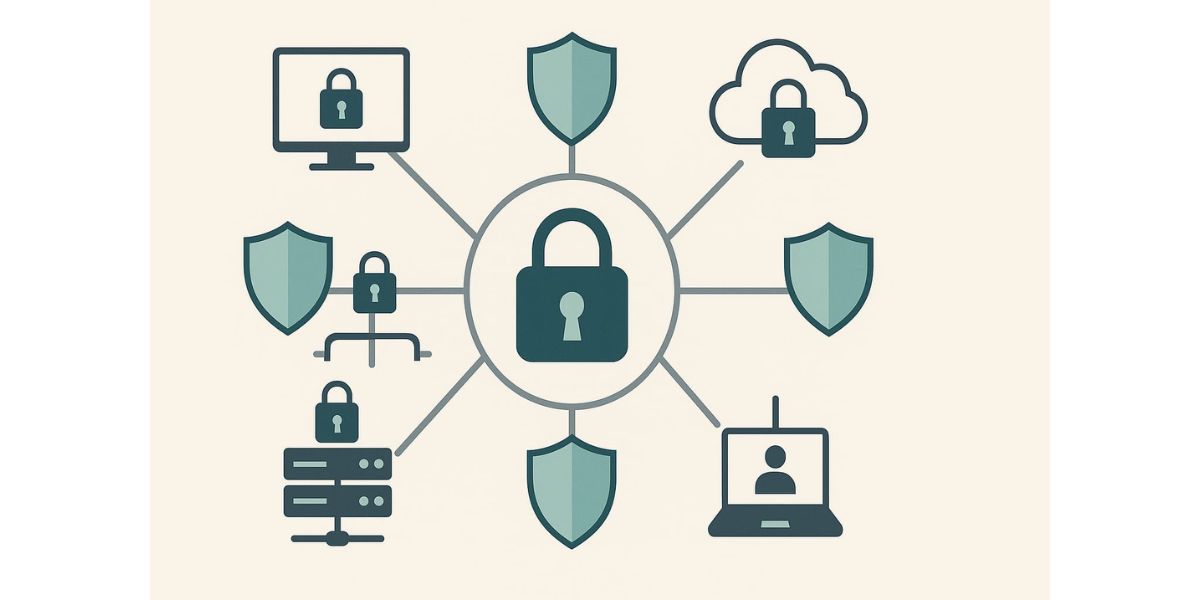
In any modern security architecture, the role of privileged accounts and the systems that manage them cannot be overstated.
Definition and Role
Privileged access management architecture refers to the design and implementation of controls, systems and policies that govern access to high-level administrative accounts, critical systems, sensitive data stores and infrastructure components. These accounts might be root accounts, domain controllers, cloud administrator accounts, or service-accounts with broad permissions.
In the context of overall security architecture, PAM is a vital component because if a privileged account is compromised, an attacker often gains broad access and can move laterally, escalate privileges, exfiltrate data or disrupt services.
How PAM Supports Zero Trust Through Least Privilege
Here’s how a well-designed privileged access management architecture supports the broader security architecture — especially zero trust:
- Enforcing least privilege: Privileged accounts are constrained to only those rights they need for the least time needed. This reduces risk.
- Session management and auditing: PAM tools monitor and log privileged sessions, ensuring full visibility into what admins or services are doing. This supports compliance and incident investigations.
- Just-in-time (JIT) access: Rather than always-on admin accounts, PAM may grant elevated access only when needed, for a limited period, then revoke it automatically.
- Credential vaulting: Secrets and privileged credentials are securely stored and managed, reducing risks from password leaks or credential reuse.
- Integration with identity and access management (IAM): PAM becomes part of identity verification, MFA, device posture — aligning with zero trust principles of verifying identity and device before granting access.
In short, privileged access management architecture is a core pillar of the overall security architecture. Without it, even a good zero trust or cloud security design may be undermined by misuse of privileged credentials.
Integrating Zero Trust and Cloud Security Architectures
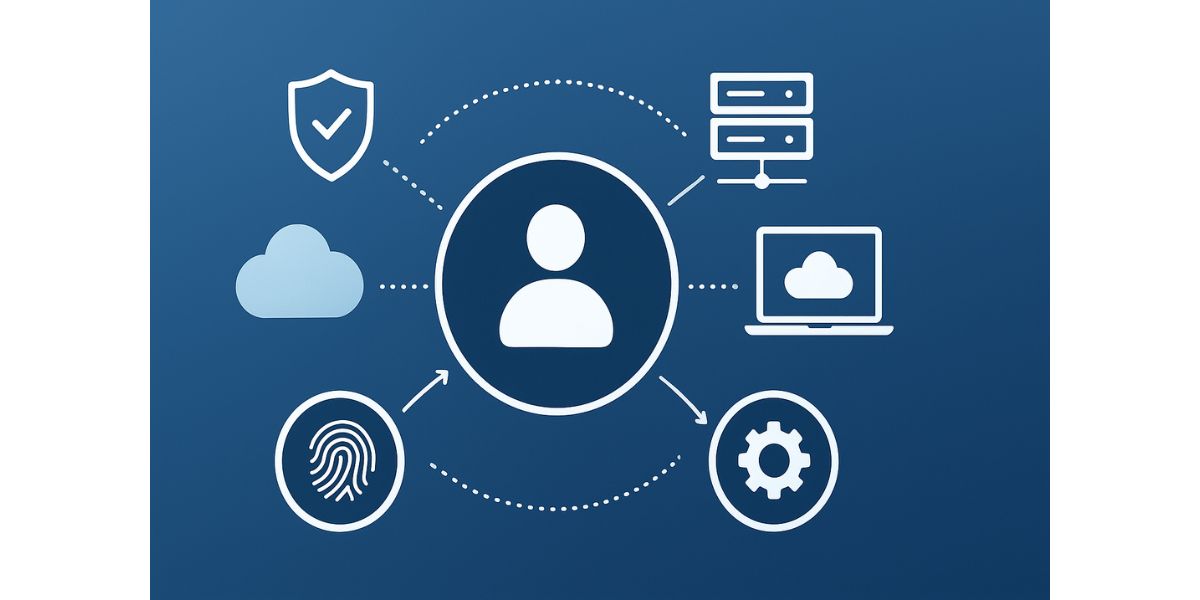
We’ve covered zero trust security architecture and cloud security architecture separately. Now let’s look at how organisations can integrate them into a unified, modern security architecture.
Identity-Centric Security
In a blended architecture, identity becomes the central axis. Users, devices, services — whether on-premises or in the cloud — must be verified, authorised and monitored. This means:
- Using federated identity, single sign-on (SSO) and MFA across cloud and on-prem systems.
- Applying identity governance so that accounts, roles and entitlements are regularly reviewed and adjusted.
- Treating service-to-service identity the same way as user identity (e.g., machine identities in cloud).
By focusing on identity, you merge the zero trust idea (“never trust, always verify”) with the cloud security architecture requirement (“identity is the new perimeter”).
Continuous Verification and Monitoring
Another key integration point is continuous verification: instead of one-time access approval, the security architecture monitors context (device posture, location, behaviour, risk score) and revisits access decisions dynamically. In cloud-native and hybrid models, this ensures that threats emerging after initial login are detected and mitigated.
Automation and Orchestration
Cloud environments evolve rapidly: resources spin up, configurations change, workloads migrate. A manual architecture cannot keep pace. By automating policy enforcement, configuration management, monitoring and remediation, organisations can maintain a consistent, enforceable architecture that spans zero trust and cloud.
Shared Responsibility & Clear Ownership
In cloud security architecture, one of the challenges is the shared responsibility model (cloud provider vs customer). In a hybrid zero trust + cloud architecture, you must clearly map responsibilities:
- Which identity controls are yours vs the provider’s?
- Which data encryption and monitoring controls are yours?
- How do you ensure compliance across your on-prem and cloud footprint?
Clear ownership ensures that the integrated architecture doesn’t leave gaps.
Unified Controls and Visibility
Finally, the security architecture should provide unified controls and visibility: a single pane of glass (or coherent set of dashboards) where you can see across on-premises, private cloud, public cloud, SaaS, and hybrid workloads. This allows security teams to respond quickly, detect anomalies, and enforce consistent policies across environments.
By integrating zero trust and cloud security architectures in this way, organisations build a modern, resilient security architecture capable of supporting digital transformation and defending against advanced threats.
Best Practices for Building a Secure Architecture
Here are some best practices you should keep in mind when building or refining your security architecture:
- Start with asset inventory and classification: Know your data, systems and services. Map flows and dependencies.
- Define the baseline architecture: Build a reference model that covers identity, devices, network, applications, data, cloud and privileged access.
- Adopt zero trust principles from the start: Assume no user or device is trusted by default; segment, verify, log, monitor.
- Design cloud-aware security architecture: Recognise that cloud brings dynamic infrastructure, elasticity, APIs, multi-tenancy — build controls accordingly.
- Embed security early (shift-left): Involve security in architecture, design and DevOps (DevSecOps). Cloud security architecture must be baked in, not bolted on.
- Enforce least-privilege access everywhere: From user accounts to service accounts to admin privileges — enforce minimal access and just-in-time elevation.
- Use automation for policy enforcement, configuration drift detection and incident response: Manual processes won’t scale.
- Ensure unified visibility and monitoring across all environments: On-premises, private cloud, public cloud, SaaS, etc.
- Apply encryption and data protection everywhere: At rest, in transit, and ensure data governance and masking where needed.
- Segment workloads and apply micro-segmentation: Both in network and in cloud contexts to limit lateral movement and contain breaches.
- Continuously review and test: Perform penetration testing, red-team exercises, review IAM policies, audit privileged access, simulate breach scenarios.
- Map and manage shared responsibility for cloud security: Know what your provider covers and what remains your responsibility.
- Align security architecture with compliance and business objectives: Make sure the architecture supports regulatory requirements and business goals, not just technical controls.
By following these best practices, you will ensure your security architecture is robust, scalable and aligned with modern threat and technology landscapes.
Conclusion
In the rapidly evolving digital landscape, crafting a solid security architecture is no longer optional — it’s essential. Modern enterprises must unite multiple architectural frameworks — whether it’s the identity-centric approach of zero trust architecture definition, the dynamic demands of cloud security architecture, the expansive nature of cloud computing security architecture, and the rigour of privileged access management architecture — into a unified, coherent design.
At the heart of this transformation is the need to assume breach, enforce verification, apply least privilege, embed security in both process and automation, and maintain continuous visibility and control. Organisations that build architecture with these principles are better positioned to protect their assets, ensure compliance, support growth, and respond to threats.
If you’re seeking expert guidance to build or refine your security architecture — whether you’re adopting zero trust, migrating to cloud, or strengthening privileged access controls — consider partnering with a trusted global firm. Trevonix, headquartered in London, specialises in Identity & Access Management (IAM) solutions and supports organisations across the UK, US, Europe, Middle East, APAC and ANZ. With Trevonix’s global expertise, your enterprise security architecture journey can be guided, structured and aligned with the best practices outlined above.