


In today’s digital enterprise landscape, identity has become the new security perimeter. As organizations expand their cloud infrastructure, adopt SaaS applications, and support remote workforces, managing who has access to what has become increasingly complex. This is where Identity Governance and Administration (IGA) platforms play a critical role.
Two of the most prominent platforms in the IGA space are SailPoint and Saviynt. Both solutions help organizations control digital identities, manage access rights, and ensure compliance with regulatory standards. However, despite their similar goals, the platforms differ significantly in architecture, capabilities, and deployment models.
Enterprises evaluating SailPoint vs Saviynt often face a complex decision. Both platforms provide powerful identity governance and administration capabilities, but their strengths cater to different types of organizations and operational priorities. Compliance-driven industries such as finance, healthcare, insurance, and government agencies often need deeper governance capabilities, automated certifications, and strong audit trails.
Choosing between SailPoint and Saviynt is not just a technical decision—it is a strategic one. The right platform can reduce security risks, streamline access governance, and simplify regulatory compliance. The wrong choice may lead to costly implementations, inefficient identity processes, and audit challenges.
This deep-dive comparison will explore:
- The fundamentals of IGA
- How SailPoint and Saviynt approach identity governance
- A detailed feature comparison
- Real-world use cases
- Strengths and limitations of each platform
- Guidance for compliance-focused enterprises selecting the right solution
By the end of this guide, decision-makers will have a clear understanding of how SailPoint vs Saviynt compares across the key areas of identity governance and administration, automation, compliance, and risk management.
Table of Contents
- What is IGA and Why It Matters
- Overview of SailPoint
- Overview of Saviynt
- SailPoint vs Saviynt – Feature Comparison
- Real-World Use Cases
- Strengths and Limitations
- Decision Guide for Compliance-Driven Enterprises
- Conclusion
What is IGA and Why It Matters
Identity Governance and Administration (IGA) is a framework of policies, technologies, and processes used to manage digital identities and control user access across an organization’s systems and applications.
Modern organizations manage thousands—or even millions—of identities across employees, contractors, partners, and customers. Without proper identity governance and administration, organizations face significant risks such as unauthorized access, insider threats, and compliance violations.
An effective IGA platform helps organizations answer critical questions:
- Who has access to what systems?
- Why do they have that access?
- Is the access appropriate for their role?
- Who approved the access?
- When should that access be revoked?
These capabilities are fundamental for regulatory compliance and cybersecurity governance.
Core components of identity governance and administration include:
Identity Lifecycle Management
Managing identities from onboarding to offboarding is one of the most critical aspects of IGA. When a new employee joins, they need appropriate access to applications and systems. When they leave, that access must be revoked immediately.
Without automated lifecycle management, organizations often face “orphaned accounts” and excessive permissions.
Access Certification
Access certification allows managers and application owners to review and validate user permissions regularly. This ensures users maintain only the access they truly need.
Access certification is essential for regulations such as SOX, HIPAA, and GDPR.
Role-Based Access Control (RBAC)
IGA platforms allow organizations to define roles and automatically assign permissions based on job functions. This simplifies identity governance and reduces manual provisioning.
Policy Enforcement
Organizations define policies that enforce least-privilege access and prevent policy violations.
Audit and Compliance
Regulators require organizations to prove they are managing identities securely. IGA solutions generate reports and audit trails that demonstrate compliance.
As organizations scale their digital environments, implementing strong identity governance and administration becomes critical. This is why platforms like SailPoint and Saviynt have become essential components of enterprise security strategies.
Overview of SailPoint
SailPoint is one of the most widely recognized leaders in the IGA market. Founded in 2005, the company has built a strong reputation for delivering enterprise-grade identity governance and administration solutions.
The platform is designed to help organizations manage identities, control access, and enforce governance policies across complex IT environments.
SailPoint’s flagship offerings include:
- Identity Security Cloud
- IdentityIQ
- IdentityNow
These solutions provide organizations with a centralized platform for managing digital identities and access rights.
Key Capabilities of SailPoint
1. Identity Lifecycle Management
SailPoint automates identity lifecycle processes such as onboarding, role assignment, and offboarding.
2. Access Certification
Managers can review and approve access rights through automated certification campaigns.
3. Role Management
Organizations can define roles that align with job functions and enforce role-based access control.
4. AI-Driven Identity Insights
SailPoint uses machine learning to analyze access patterns and identify risky permissions.
5. Integration Ecosystem
The platform integrates with hundreds of enterprise applications, cloud services, and identity providers.
Because of its maturity and scalability, SailPoint is commonly used by large enterprises with complex governance requirements.
Overview of Saviynt
Saviynt is a modern cloud-native IGA platform designed to support digital transformation and cloud-first enterprises.
Founded in 2010, Saviynt has rapidly gained traction due to its strong capabilities in identity governance and administration, particularly for cloud applications and SaaS environments.
Unlike some traditional IGA platforms, Saviynt was designed with cloud architecture from the beginning.
Key Capabilities of Saviynt
1. Cloud-Native Architecture
Saviynt provides identity governance for cloud environments such as AWS, Azure, and Google Cloud.
2. Enterprise Identity Cloud
Saviynt offers a unified identity platform covering:
- IGA
- Privileged Access Management
- Cloud security
3. Advanced Risk Analytics
Saviynt includes strong analytics capabilities to detect risky access patterns.
4. Compliance Automation
The platform simplifies regulatory compliance through automated certifications and policy enforcement.
5. DevOps-Friendly Integration
Saviynt integrates easily with modern DevOps and cloud infrastructures.
Because of its cloud-first design, Saviynt is particularly attractive to organizations adopting modern digital ecosystems.
SailPoint vs Saviynt – Feature Comparison
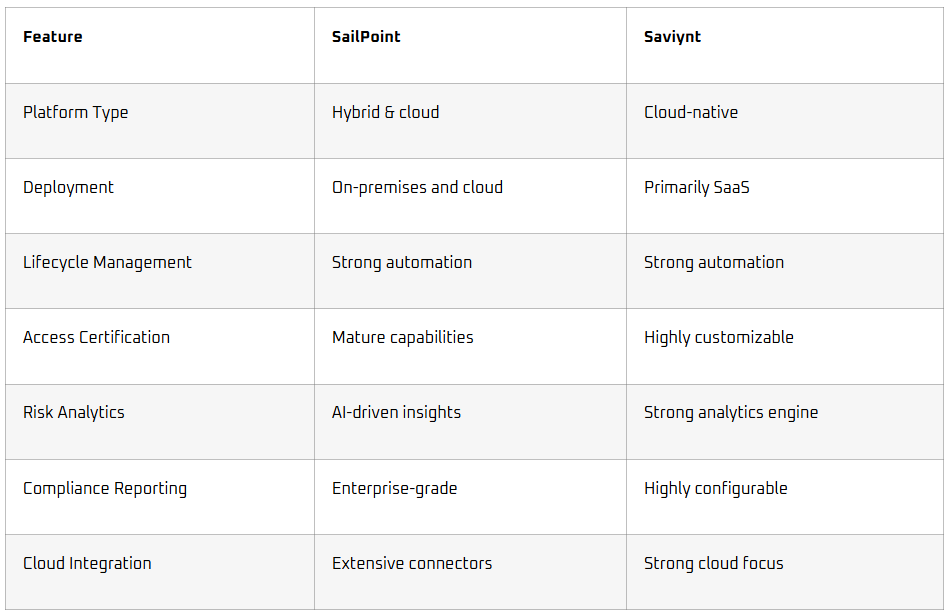
When evaluating SailPoint vs Saviynt, organizations must consider multiple aspects of identity governance and administration, including lifecycle management, analytics, compliance automation, and deployment flexibility.
Below is a detailed comparison of how SailPoint and Saviynt differ across key areas.
Identity Lifecycle Management
Lifecycle management is a core function of identity governance and administration platforms.
Both SailPoint and Saviynt offer automated provisioning and de-provisioning.
SailPoint
SailPoint provides robust lifecycle management capabilities that integrate with HR systems, directories, and enterprise applications.
The platform automatically:
- Creates accounts
- Assigns access based on roles
- Removes access during offboarding
Saviynt
Saviynt provides similar lifecycle automation but places a stronger emphasis on cloud applications.
Saviynt’s architecture enables rapid provisioning across SaaS platforms, making it attractive for organizations operating cloud-centric environments.
Access Governance & Certification
Access certification is essential for maintaining strong IGA controls.
SailPoint
SailPoint is widely known for its mature certification campaigns and policy management.
Managers and auditors can review access permissions and ensure compliance with governance policies.
Saviynt
Saviynt provides flexible certification workflows that can be customized for specific compliance requirements.
Organizations can automate certification campaigns across multiple applications.
Both SailPoint and Saviynt perform well in this area of identity governance and administration.
Risk Analytics and Reporting
Analytics help organizations identify high-risk access patterns.
SailPoint
SailPoint includes AI-driven identity analytics that detect anomalies in user access.
These capabilities help security teams identify excessive privileges.
Saviynt
Saviynt offers powerful reporting dashboards and risk scoring models.
Security teams can analyze access violations and compliance risks using advanced analytics.
Both platforms provide strong analytics capabilities for IGA programs.
Cloud & Hybrid Support
Modern organizations operate hybrid IT environments that include both on-premises and cloud systems.
SailPoint
SailPoint supports both cloud and on-premise deployments, making it suitable for organizations with legacy infrastructure.
Saviynt
Saviynt focuses heavily on cloud environments.
The platform integrates easily with major cloud providers and SaaS applications.
For cloud-first organizations, Saviynt may provide a more streamlined experience.
Automation & AI
Automation improves operational efficiency and reduces manual identity management tasks.
SailPoint
SailPoint uses AI-based identity analytics to recommend access decisions and detect risky access patterns.
Saviynt
Saviynt incorporates automation and analytics to streamline access approvals and certification processes.
Both platforms leverage automation to strengthen identity governance and administration practices.
Compliance and Audit Capabilities
Compliance is one of the most important reasons organizations deploy IGA platforms.
SailPoint
SailPoint provides extensive audit trails, policy enforcement, and compliance reporting capabilities.
These features help organizations meet regulatory requirements such as SOX and HIPAA.
Saviynt
Saviynt also offers strong compliance automation, allowing organizations to generate audit reports and track policy violations.
Compliance-focused enterprises will find both SailPoint and Saviynt capable platforms for identity governance and administration.
Real-World Use Cases
Both SailPoint and Saviynt are widely used across industries where identity security and regulatory compliance are critical.
Financial Services
Banks and financial institutions must comply with strict regulations.
IGA platforms help enforce access controls and generate compliance reports for audits.
Healthcare
Healthcare organizations must protect sensitive patient data.
Identity governance ensures only authorized personnel can access medical records.
Government
Government agencies manage large numbers of identities and require strong governance frameworks.
Retail and E-commerce
Retail organizations manage identities across employees, partners, and customers.
Strong identity governance and administration ensures secure access to critical systems.
Strengths and Limitations
SailPoint Strengths
- Mature enterprise platform
- Strong identity analytics
- Extensive integration ecosystem
- Proven scalability
SailPoint Limitations
- Complex implementation
- Higher operational overhead
Saviynt Strengths
- Cloud-native architecture
- Strong analytics capabilities
- Flexible compliance workflows
Saviynt Limitations
- Limited on-premise flexibility
- Learning curve for configuration
Decision Guide for Compliance-Driven Enterprises
Choosing between SailPoint vs Saviynt depends on several factors.
Choose SailPoint if:
- Your organization has complex hybrid infrastructure
- You require mature enterprise identity governance capabilities
- You need extensive integration support
Choose Saviynt if:
- Your organization is cloud-first
- You want strong SaaS and cloud governance capabilities
- You prefer modern architecture and deployment models
Ultimately, both SailPoint and Saviynt provide powerful IGA solutions.
The right choice depends on your organization’s infrastructure, compliance requirements, and long-term identity strategy.
Conclusion
Identity security has become a cornerstone of modern cybersecurity strategies. As organizations expand their digital ecosystems, implementing strong identity governance and administration is essential for reducing risk, enforcing compliance, and protecting sensitive data.
Both SailPoint and Saviynt offer powerful IGA platforms capable of managing complex identity environments. While SailPoint provides a mature and scalable solution suited for hybrid infrastructures, Saviynt excels in cloud-native identity governance and modern SaaS ecosystems.
For compliance-driven enterprises, the decision between SailPoint vs Saviynt should be based on infrastructure strategy, regulatory requirements, and long-term identity management goals.
However, selecting and implementing the right IGA platform is only part of the journey. Organizations also need expert guidance to design identity governance frameworks, configure access policies, and ensure successful deployments.
This is where Trevonix plays a vital role.
Trevonix is a global cybersecurity and identity solutions company headquartered in London, helping enterprises implement secure identity ecosystems. With deep expertise in identity governance and administration, Trevonix supports organizations in deploying platforms such as SailPoint and Saviynt, optimizing governance frameworks, and ensuring regulatory compliance.
By combining strategic consulting, implementation expertise, and identity security best practices, Trevonix enables enterprises to build resilient and compliant identity infrastructures for the digital era.