

Modern organizations operate in a digital environment where identity has become the new security perimeter. Employees access applications from multiple devices, partners collaborate through shared systems, and customers interact through digital platforms. With such complexity, controlling who has access to what is critical to protecting data and infrastructure.
This is where PAM, IAM, and IGA come into play. These three identity security frameworks help organizations manage digital identities, control access, and ensure compliance across complex IT environments.
However, many organizations confuse these solutions or assume they are interchangeable. In reality, PAM, IAM, and IGA serve different but complementary purposes in an enterprise security architecture.
Understanding PAM vs IAM vs IGA is essential for building a strong identity security strategy. While IAM focuses on authentication and access management, PAM protects high-risk privileged accounts, and IGA ensures governance, compliance, and lifecycle control of identities.
Without the right balance between these three solutions, organizations risk:
- Unauthorized access
- Insider threats
- Privileged account abuse
- Compliance failures
- Operational inefficiencies
In this guide, we will break down:
- What IAM, PAM, and IGA mean
- The differences between PAM vs IAM, IAM vs IGA, and PAM vs IGA
- How these systems work together in modern enterprises
- Why organizations need all three technologies
By the end of this article, you will clearly understand how PAM, IAM, and IGA complement each other to create a secure and scalable identity management framework.
Table of Contents
- What Is IAM (Identity and Access Management)?
- What Is PAM (Privileged Access Management)?
- What Is IGA (Identity Governance and Administration)?
- PAM vs IAM – What’s the Difference?
- IAM vs IGA – What’s the Difference?
- PAM vs IGA – How Do They Compare?
- Why Your Organisation Needs PAM, IAM, and IGA Together
- How PAM, IAM, and IGA Work Together in a Modern Enterprise
- Common Mistakes Organisations Make
- Conclusion
What Is IAM (Identity and Access Management)?
IAM (Identity and Access Management) is the framework used by organizations to manage digital identities and control user access to systems, applications, and data.
At its core, IAM ensures that the right individuals have the right access to the right resources at the right time.
IAM systems authenticate users, authorize their access levels, and enforce security policies across enterprise environments.
Key Functions of IAM
An IAM platform typically provides several essential capabilities:
Identity Authentication
Authentication verifies that a user is who they claim to be. IAM platforms support multiple authentication methods including:
- Password authentication
- Multi-factor authentication (MFA)
- Biometrics
- Single Sign-On (SSO)
These mechanisms help protect systems from unauthorized access.
Access Control
IAM systems manage who can access which applications or systems. This is usually implemented through:
- Role-based access control (RBAC)
- Attribute-based access control (ABAC)
- Policy-based access management
Single Sign-On (SSO)
SSO allows users to log in once and access multiple systems without re-entering credentials. This improves both security and user experience.
Identity Lifecycle Management
IAM systems also manage identity lifecycle events such as:
- Employee onboarding
- Role changes
- Employee offboarding
Automating these processes ensures that access privileges stay up-to-date.
Why IAM Is Important
Without IAM, organizations would struggle to manage identity access across hundreds or thousands of systems.
IAM helps organizations:
- Reduce password fatigue
- Improve security posture
- Enhance user productivity
- Enforce access policies
- Support digital transformation
However, while IAM is powerful, it does not fully address privileged access risks or governance requirements. That is where PAM and IGA come into the picture.
What Is PAM (Privileged Access Management)?
PAM (Privileged Access Management) focuses on protecting and controlling privileged accounts—accounts that have elevated permissions within IT environments.
These accounts often belong to:
- System administrators
- Database administrators
- Network engineers
- DevOps teams
- Automated service accounts
Because privileged accounts have extensive system access, they are a prime target for cyber attackers.
Why Privileged Accounts Are High Risk
A compromised privileged account can allow attackers to:
- Disable security tools
- Access sensitive databases
- Modify system configurations
- Deploy malware
- Move laterally across networks
Many large-scale data breaches have involved stolen or misused privileged credentials.
This is why PAM plays a critical role in modern cybersecurity strategies.
Key Capabilities of PAM
Privileged Credential Vaulting
PAM solutions store privileged credentials securely in encrypted vaults.
This prevents administrators from knowing or sharing actual passwords.
Privileged Session Monitoring
PAM platforms monitor privileged sessions in real time, allowing security teams to:
- Track administrator activities
- Record sessions
- Detect suspicious behavior
Just-in-Time Privileged Access
Instead of permanent admin rights, PAM grants temporary elevated privileges when needed.
Once the task is complete, privileges are automatically revoked.
Least Privilege Enforcement
PAM enforces the principle of least privilege, ensuring users only receive the minimum permissions required.
Why PAM Is Essential
Privileged accounts represent one of the biggest attack surfaces in enterprise environments.
PAM helps organizations:
- Prevent privilege escalation
- Protect critical systems
- Reduce insider threats
- Monitor high-risk access
- Strengthen compliance posture
While IAM manages general access, PAM focuses on the most sensitive and powerful accounts.
What Is IGA (Identity Governance and Administration)?
IGA (Identity Governance and Administration) focuses on governance, compliance, and lifecycle oversight of identities and access rights.
While IAM handles authentication and access control, IGA ensures those access rights are appropriate, auditable, and compliant.
IGA provides visibility into who has access to what and why.
Core Capabilities of IGA
Access Certification
Access certification processes require managers to periodically review and approve user access rights.
This ensures employees only retain necessary permissions.
Identity Lifecycle Governance
IGA governs the entire identity lifecycle:
- Joiner processes
- Role changes
- Access revocation
Policy Enforcement
IGA enforces governance policies such as:
- Segregation of duties
- Access approval workflows
- Risk-based access control
Compliance Reporting
Organizations must comply with regulations like:
- GDPR
- SOX
- HIPAA
IGA platforms generate compliance reports showing how access is controlled and reviewed.
Why IGA Matters
Without governance, identity systems become chaotic over time.
Employees accumulate excessive permissions, creating access sprawl.
IGA helps organizations:
- Maintain compliance
- Prevent access creep
- Improve audit readiness
- Strengthen identity governance
- Enhance visibility across identity systems
While IAM grants access, IGA ensures that access is appropriate and controlled.
PAM vs IAM – What’s the Difference?
The comparison between PAM vs IAM often causes confusion because both solutions deal with identity and access control.
However, they serve different purposes within enterprise security architecture.
Key Difference Between PAM vs IAM

Practical Example
Imagine a company employee logging into corporate applications.
- IAM verifies the employee’s identity and allows access to business applications.
- PAM controls what happens when an administrator logs into critical systems like servers or databases.
This distinction highlights the PAM vs IAM difference.
IAM manages general identities, while PAM protects powerful accounts with elevated privileges.
Organizations often deploy IAM first and then add PAM to secure privileged accounts.
IAM vs IGA – What’s the Difference?
Another common comparison is IAM vs IGA.
While these technologies appear similar, they address different aspects of identity management.
Core Difference Between IAM vs IGA
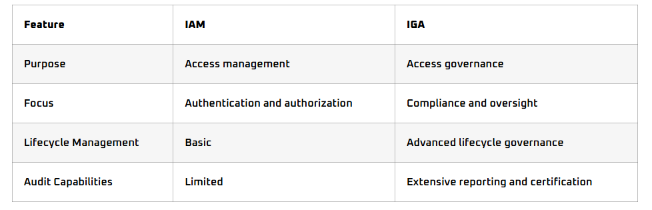
How IAM and IGA Work Together
In the IAM vs IGA relationship:
- IAM systems grant access
- IGA systems govern and review access
For example:
- IAM allows an employee to access a financial system.
- IGA periodically checks whether that employee should still have access.
Without governance, access rights can accumulate over time.
This is why the IAM vs IGA discussion is less about competition and more about complementary capabilities.
PAM vs IGA – How Do They Compare?
The PAM vs IGA comparison focuses on privileged security versus governance oversight.
Key Differences Between PAM vs IGA
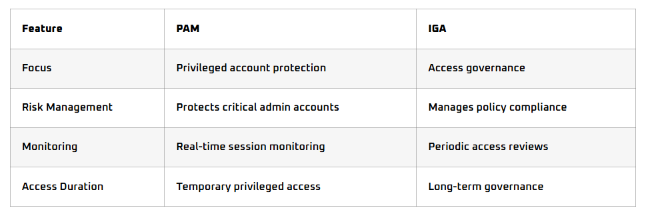
Example Scenario
Consider a database administrator.
- PAM ensures the administrator receives privileged access only when required.
- IGA ensures that the administrator’s access rights are periodically reviewed and approved.
This demonstrates the relationship between PAM vs IGA.
PAM focuses on protecting high-risk access, while IGA focuses on governing identity permissions across the organization.
Why Your Organisation Needs PAM, IAM, and IGA Together
Organizations often ask whether they should implement PAM, IAM, or IGA.
The correct answer is all three.
Each technology addresses a different identity security challenge.
IAM Provides Identity Control
IAM ensures that:
- Users are authenticated
- Access policies are enforced
- Employees can securely access systems
Without IAM, identity access would be chaotic.
PAM Protects Critical Accounts
PAM protects the most powerful accounts in an organization.
Without PAM, attackers who gain privileged credentials could control entire IT environments.
IGA Ensures Governance and Compliance
IGA ensures identity systems remain organized, compliant, and auditable.
Without governance, access rights become excessive and risky.
The Identity Security Triangle
Together, PAM, IAM, and IGA create a comprehensive identity security framework:
- IAM → Access
- PAM → Privileged security
- IGA → Governance
This combination allows organizations to secure digital identities across the entire enterprise.
How PAM, IAM, and IGA Work Together in a Modern Enterprise
Modern enterprises rely on integrated identity ecosystems where PAM, IAM, and IGA work together.
Step 1: Identity Creation
When a new employee joins the company:
- IAM creates the user identity.
- IGA ensures appropriate role-based access policies are applied.
Step 2: Access Provisioning
IAM grants access to required systems.
IGA verifies that permissions follow governance policies.
Step 3: Privileged Access Control
If the employee becomes an administrator:
- PAM controls privileged access
- PAM monitors administrator activities
Step 4: Continuous Governance
IGA continuously reviews user access rights.
Managers approve or revoke permissions based on policy.
Step 5: Access Removal
When an employee leaves the organization:
- IAM removes system access
- IGA confirms all access rights are revoked
- PAM removes privileged credentials
This coordinated workflow ensures that identity security remains strong throughout the identity lifecycle.
Common Mistakes Organisations Make
Many organizations struggle when implementing PAM, IAM, and IGA due to misunderstandings or incomplete strategies.
Treating PAM vs IAM as the Same Solution
Some organizations believe IAM alone is sufficient.
However, without PAM, privileged accounts remain vulnerable.
Ignoring Governance
Many organizations deploy IAM but ignore governance.
Without IGA, access permissions accumulate over time.
Overlooking Privileged Accounts
Privileged accounts are often poorly managed.
Implementing PAM ensures these accounts are protected.
Lack of Integration
Identity systems must integrate seamlessly.
Disconnected IAM, PAM, and IGA solutions create security gaps.
Conclusion
In today’s digital enterprise, identity security has become one of the most critical aspects of cybersecurity strategy. Understanding the differences between PAM, IAM, and IGA helps organizations build a stronger and more resilient identity management framework.
While IAM focuses on authentication and access control, PAM secures privileged accounts, and IGA ensures governance and compliance across identity systems. The comparisons between PAM vs IAM, IAM vs IGA, and PAM vs IGA highlight that these technologies are not competing solutions—they are complementary layers of identity security.
Organizations that rely on only one of these approaches often face gaps in security visibility, privileged access protection, or governance oversight. Implementing PAM, IAM, and IGA together enables enterprises to manage identities effectively, protect sensitive systems, enforce compliance, and reduce security risks.
As identity ecosystems grow more complex with cloud adoption, remote work, and digital transformation, integrating these solutions becomes even more important.
Companies looking to modernize their identity security architecture often work with experienced identity specialists who understand how to implement and optimize these technologies across enterprise environments.
Trevonix, a global identity and cybersecurity consulting company headquartered in London, helps organizations design and implement advanced identity security solutions including PAM, IAM, and IGA. With expertise in modern identity platforms and enterprise security architecture, Trevonix enables businesses to strengthen identity governance, protect privileged access, and build scalable identity infrastructures for the future.