
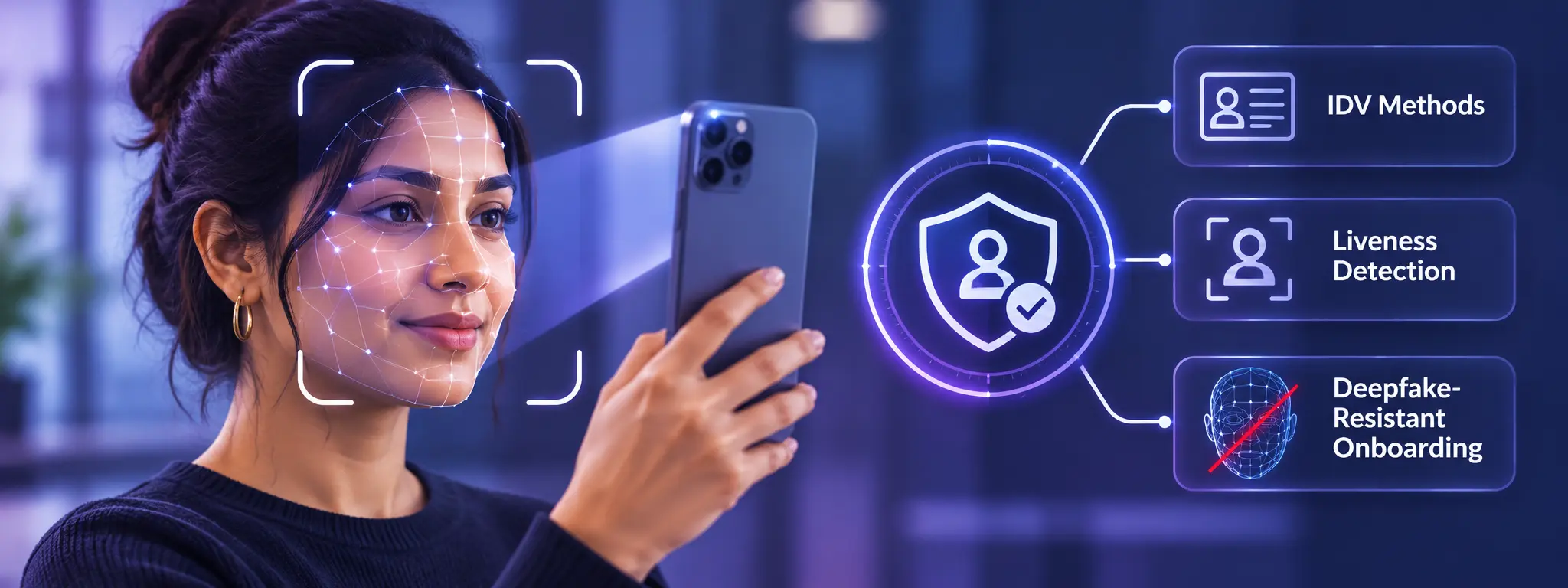
Modern identity verification combines document checks, biometric analysis, artificial intelligence (AI) and liveness detection to establish trust. However, the growing use of deepfakes and sophisticated spoofing techniques means organisations must strengthen their digital onboarding processes to address emerging threats.
What Is Identity Verification (IDV)?
Identity verification is the process of confirming an individual's identity using trusted documents, personal information or biometric characteristics. It helps organisations establish whether a person is genuine before granting access to services, accounts or sensitive information.
Unlike basic data collection, effective identity verification validates the information provided against reliable sources and checks for signs of manipulation or impersonation.
Why Identity Verification Matters for Digital Onboarding
Digital onboarding enables customers and employees to register remotely without visiting a physical location. However, it also creates opportunities for fraudsters to use stolen documents, synthetic identities or manipulated facial images.
A robust identity verification process helps businesses reduce fraudulent registrations, support regulatory compliance, protect customer information and improve confidence in digital services. When implemented correctly, it balances security with a smooth user experience.
How Does Identity Verification Work?
Although implementations differ, the process generally follows four stages:
- Information collection: The user submits personal details and identity documents.
- Document validation: Automated checks assess document authenticity and extract relevant information.
- Biometric verification: Facial images or other biometric characteristics are compared with the submitted evidence.
- Risk assessment: The system evaluates discrepancies, suspected fraud and verification results before approving, rejecting or escalating the application.
Organisations should also maintain appropriate audit records and provide secure processes for handling failed checks.
Common Identity Verification Methods
Document Verification
Document verification checks passports, driving licences and other accepted identity documents. Optical character recognition (OCR) extracts information, while security-feature analysis, format validation and tampering detection help identify suspicious documents.
Where appropriate, details can also be checked against trusted databases or authoritative sources.
Biometric Identity Verification
Biometric identity verification uses distinctive human characteristics, such as facial features or fingerprints, to help establish identity. It can reduce reliance on manually entered information, although biometric data must be handled carefully because of privacy and security risks.
Facial Recognition and Face Matching
Face matching compares a live facial image with the photograph on an identity document or another trusted reference. The system calculates a similarity score to help determine whether the images belong to the same person.
Lighting, image quality, demographic performance differences and presentation attacks can affect accuracy, so facial matching should not be treated as proof of identity on its own.
Liveness Detection: What It Is and How It Works
Liveness detection determines whether a biometric sample comes from a real, present person rather than a photograph, video replay, mask or other artificial representation.
It strengthens identity verification by examining facial movements, visual patterns, depth cues or other signals that help distinguish genuine human presence from an attempted spoof.
Passive vs Active Liveness Detection
Passive liveness detection analyses a user's image or video without requiring specific actions. It can make onboarding quicker and more convenient.
Active liveness detection asks users to complete a challenge, such as turning their head or following an on-screen instruction. Although this can provide additional evidence, poorly designed challenges may inconvenience users or still be vulnerable to sophisticated attacks.
The most suitable approach depends on the organisation's risk exposure, user experience requirements and available technology.
How Liveness Detection Helps Prevent Spoofing
Liveness detection can identify attempts to use printed photographs, screen replays or certain manipulated biometric samples. Combined with document checks and face matching, it creates multiple layers of protection.
However, no single technique can prevent every attack. Organisations should evaluate detection performance against realistic threats and update their controls as attack methods evolve.
Deepfakes and the New Identity Verification Challenge
Deepfakes use AI to generate or manipulate realistic images, videos and voices. Fraudsters may exploit these technologies to impersonate genuine customers, bypass remote onboarding controls or support account takeover attempts.
Traditional face matching may struggle when presented with convincing synthetic media. Consequently, businesses need identity verification systems that evaluate several independent signals rather than relying exclusively on facial similarity.
How Identity Verification Can Become Deepfake-Resistant
A stronger onboarding framework combines document authenticity checks, biometric matching, presentation-attack detection and analysis designed to identify synthetic media.
Additional safeguards may include device intelligence, transaction risk signals, consistency checks and human review for suspicious cases. High-risk applications can trigger enhanced verification rather than automatic approval.
Deepfake-resistant onboarding should be understood as a layered security approach, not a guarantee that fraud is impossible.
Identity Verification for Digital Onboarding
An effective digital onboarding journey should be secure, accessible and straightforward. Organisations should minimise unnecessary data collection, explain verification requirements clearly and offer alternative review methods when automated checks fail.
For financial services, healthcare and other regulated sectors, workflows should reflect applicable legal obligations, risk levels and record-keeping requirements.
Identity Verification vs Authentication: What Is the Difference?
Identity verification establishes that a person is who they claim to be, typically during registration or account creation. Authentication checks whether someone attempting to access an account is an authorised user.
For example, a customer may complete document and facial checks when opening an account, then use a passkey or multi-factor authentication (MFA) to sign in. Both controls are important, but they address different stages of the identity lifecycle.
How to Choose an Identity Verification Solution
Evaluate solutions against document coverage, biometric accuracy, liveness detection capabilities, deepfake resistance, integration options, scalability and user experience. Also assess data protection practices, regulatory support, accessibility and the provider's ability to explain verification decisions.
Pilot testing against realistic fraud scenarios can help determine whether a solution meets operational and security requirements.
Identity Verification Best Practices
Organisations should apply risk-based verification, use multiple complementary controls, protect biometric information, monitor suspicious activity and regularly test their systems. They should also define clear escalation procedures, restrict access to verification records and review vendor performance as threats change.
Common Identity Verification Challenges
Common challenges include sophisticated fraud, false rejections, poor-quality documents, privacy concerns, integration complexity and inconsistent performance across user groups. Addressing these issues requires continuous testing, transparent policies and a balance between security and accessibility.
How AI Is Changing Identity Verification
AI can accelerate document analysis, detect unusual patterns and help identify manipulated media. However, attackers also use AI to create more convincing impersonations. Businesses should therefore evaluate AI systems carefully, monitor false-positive and false-negative rates, and retain human oversight for complex decisions.
How Trevonix Can Support Identity and Access Security
Strong onboarding is only one part of a comprehensive identity security strategy. Organisations must also manage access permissions, protect privileged accounts and continuously assess identity-related risks.
Trevonix, a global cybersecurity company headquartered in London, supports organisations with identity and access management (IAM) advisory, architecture, implementation, integration and managed services. Its expertise can help businesses strengthen identity controls, improve access governance and align onboarding security with broader identity protection initiatives.
Explore Trevonix identity and access management solutions to understand how a structured identity security strategy can support a more secure digital environment.
Conclusion
Identity verification is evolving as deepfakes and automated fraud become more sophisticated. Combining document validation, biometrics, liveness detection, AI-based risk analysis and ongoing security controls helps organisations build stronger digital onboarding processes.
The goal is not simply to verify an identity once, but to establish trust through layered, risk-based security that protects users while supporting a seamless digital experience.