Nobody installed ransomware and nobody stole a database. The attackers changed settings on equipment that was reachable and administrable. For identity and access people, that is the whole story.
What happened
According to Al Jazeera's reporting, problems appeared on Monday 2 November in Belgium, Estonia, Finland, Ireland, Italy, Luxembourg, the Netherlands, Portugal and Sweden. On 3 November Germany and Romania reported supermarket incidents, and the UK's National Cyber Security Centre said hackers had targeted small meat-processing firms with minimal impact. On 4 November French authorities reported that temperature and defrost thresholds had been set far too high on cold storage at at least three blood banks. Products were moved, none were damaged, and no patients were harmed.
In Belgium, dozens of stores across several chains reported refrigeration failures and federal prosecutors opened an investigation. In Italy, about 20 supermarkets were hit, and Coop's Sicily group said four of its 300 stores were affected. Coop Sweden said equipment at seven stores was affected overnight and has since returned to normal. An EU spokesperson said these are "not isolated incidents" and that EU agencies are working with national authorities on a joint response.
How they got in
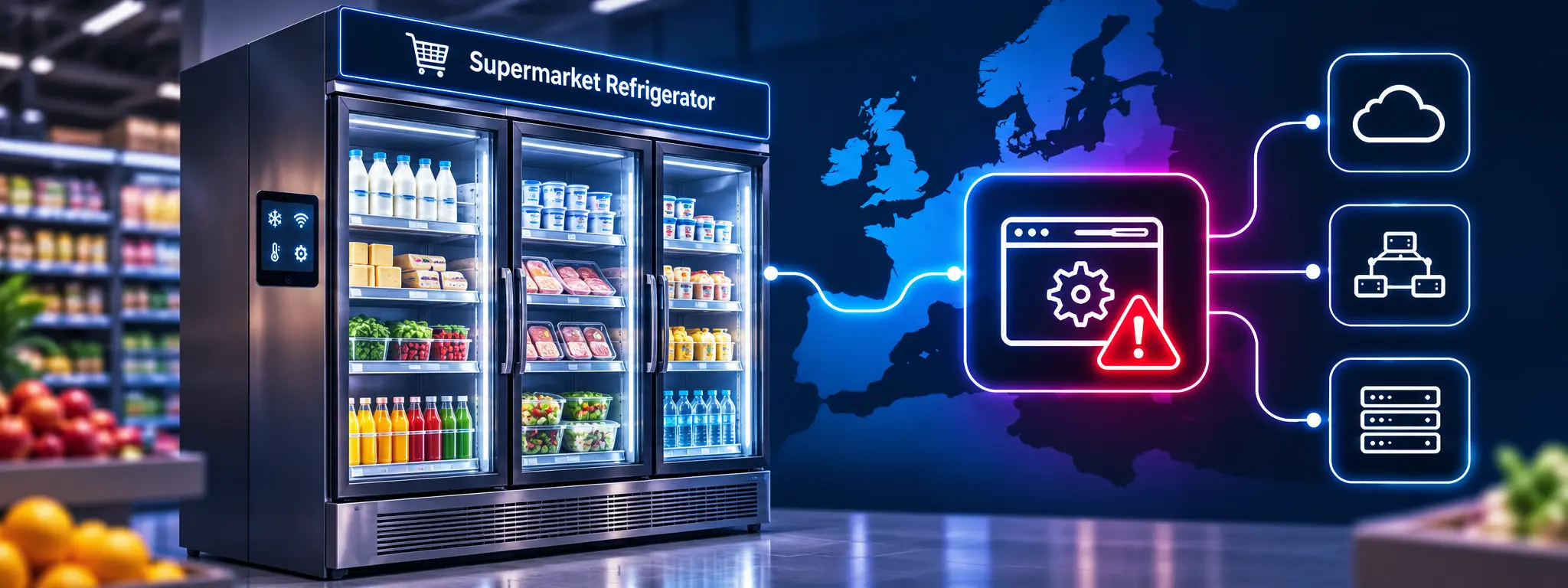
This is the part to read carefully, because the public picture is incomplete. The DomainTools analysis says the attackers reached refrigeration management interfaces and changed defrost and temperature settings, using the controllers' own legitimate functions rather than custom malware. It describes the method as trivial and puts the success down mainly to internet exposure and weak administration. Targeted equipment reportedly included Danfoss AK-SM controllers, and the Danish maker recommended that its systems not be directly reachable from the internet. The same analysis says the initial access method for the November wave is unresolved, and it does not confirm that any specific vulnerability was exploited.
The exposure itself is measurable. Flare identified at least 2,667 public IP addresses tied to refrigeration management interfaces, and in a sample of 547 confirmed addresses, 356 also exposed other services such as remote desktop, cameras and VPNs. On the Coop Sweden side, the affected equipment was connected over old 4G networks, and the company has accelerated an upgrade to 5G and modern modems.
Who did it is still contested
France formally attributed the October attacks to a group it links to Iran's IRGC, according to the DomainTools page, which also notes that the forensic evidence is not public. NoName057(16) and Z-Pentest published a claim of responsibility, which the same analysis rates as likely propaganda. Romania's cybersecurity director said the attack "seems semi-amateurish" and that he does not suspect a state actor. No group has been confirmed for the November wave. We would treat the attribution as open and the lesson as settled, because the defences are the same whoever is behind it.
Why this belongs in an IAM conversation H2
- Management interfaces are privileged access. A web console that changes setpoints and alarm thresholds is an admin plane. It deserves the controls you give any other admin plane: unique credentials, MFA where the product supports it, and no direct path from the internet.
- Contractors set these up. Refrigeration and building systems are often installed and maintained by third parties. The accounts, remote access and exposed ports they leave behind rarely appear in the identity inventory.
- Devices are identities too. A controller with a factory password and a public address is a non-human identity nobody owns. Ownership, credential rotation and decommissioning apply to it as much as to a service account.
- End-of-life equipment has no good answer. The DomainTools analysis notes that some of the controllers involved are end-of-life and may no longer get patches. Isolate them or replace them.
What to do now
- Inventory every internet-facing refrigeration and building-management interface, including ones a contractor set up. If it is reachable from the internet, take it off.
- Put administration behind a VPN or a private network path with MFA, and remove default credentials.
- Add temperature monitoring that does not depend on the controller, so a changed setpoint cannot hide itself.
- Monitor setpoints, defrost schedules and alarm thresholds for unauthorised changes, and keep logs and configuration records before any reset.
- Before reconnecting restored equipment, confirm the exposure and the credentials are fixed. Otherwise you are restoring the same weakness.
The Trevonix perspective
We keep meeting the same gap from different directions: an identity programme that covers employees and applications, and a long tail of devices, controllers and contractor accounts that sit outside it. Attackers do not respect that boundary. A fridge controller on a public address is the same finding as an unowned service account, and it responds to the same fix: know it exists, name an owner, limit what it can reach and watch what changes.
Governing people, machines and AI agents under one model, with an owner and a purpose for every identity, is how that long tail gets pulled into view. We write about it in Human, Machine, and AI Identities: Why Enterprises Need One Governance Strategy and AI Agents and Identity Security in the Enterprise.
For more information, visit www.trevonix.com or contact contact@trevonix.com.
Sources
- Al Jazeera, "EU urges action as Germany, Romania and UK report supermarket cyberattacks" (4 November 2026): https://www.aljazeera.com/news/2026/11/4/eu-urges-action-as-germany-romania-and-uk-report-supermarket-cyberattacks
- DomainTools Investigations, "European Refrigeration Systems Cyber Sabotage": https://dti.domaintools.com/research/european-refrigeration-systems-cyber-sabotage