
Table of Contents
- Summary
- What is an Agentic Enterprise
- The 3 Critical Questions for AI Security
- Why Identity is the Foundation
- Key Capabilities in the Blueprint
- Trevonix Perspective
- Conclusion
- Reference
Summary
The enterprise landscape is entering a new phase; one powered by autonomous AI agents capable of making decisions, executing workflows, and interacting across systems. While this transformation unlocks significant productivity gains, it also introduces a new category of risk.
Unlike traditional applications, AI agents operate with increasing independence, often without continuous human oversight. This makes identity, access, and governance more critical than ever.
What is an Agentic Enterprise
An agentic enterprise is one in which AI agents act as active participants in business operations; handling tasks, accessing systems, and making decisions autonomously.
This evolution raises a fundamental challenge: How do you control what you cannot fully see?
The 3 Critical Questions for AI Security
- Where are my AI agents?
- What systems can they access?
- What actions are they authorised to perform?
Without clear visibility, organisations risk agent sprawl and uncontrolled access.
Why Identity is the Foundation
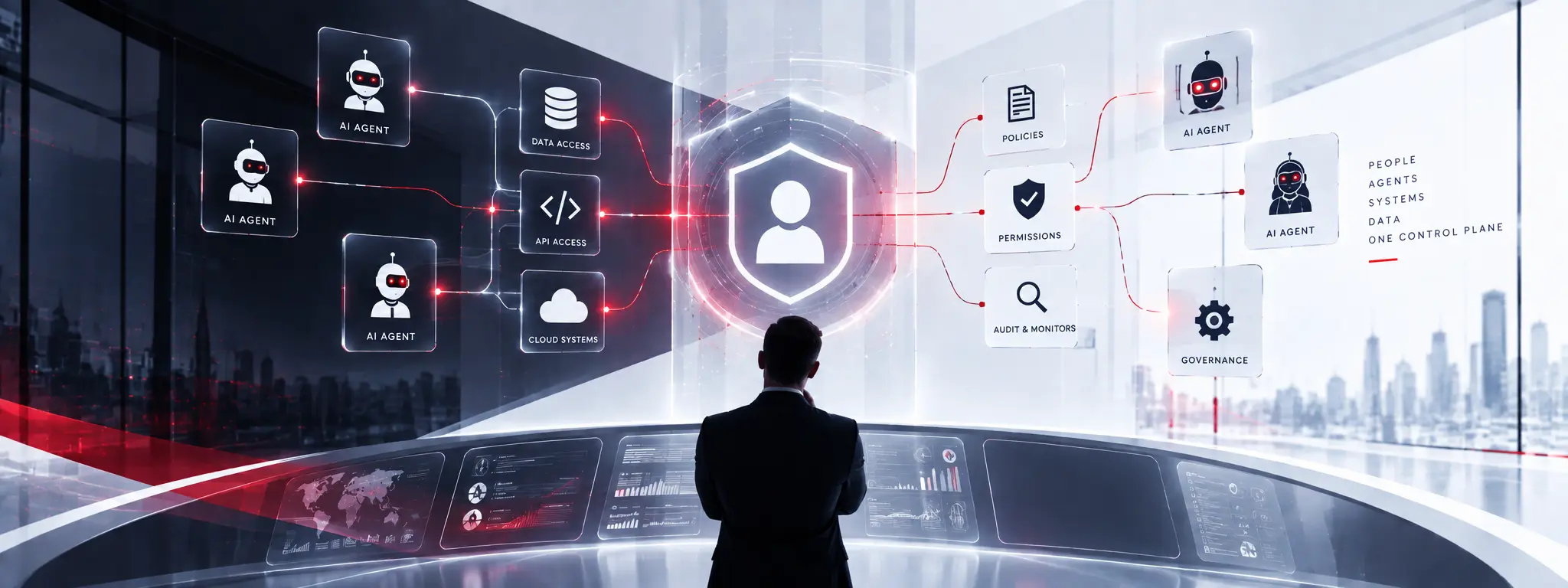
AI agents are digital actors with privileges.
- Each agent must have a distinct identity
- Access should follow least-privilege principles
- Activities must be continuously monitored and governed
This reinforces the idea that AI security is fundamentally identity security.
Key Capabilities in the Blueprint
- Agent discovery and inventory
- Access governance
- Real-time monitoring
- Kill switch mechanisms
These capabilities ensure innovation does not come at the expense of control.
Trevonix Perspective
The rise of agentic AI mirrors the shift to cloud and Zero Trust. Success will depend on embedding identity at the core of AI adoption, extending governance to machines and agents, and enabling real-time control.
Conclusion
To scale AI securely, organisations must treat AI agents as identities with strict controls and continuous oversight. Those that achieve this balance will lead the next phase of digital transformation.