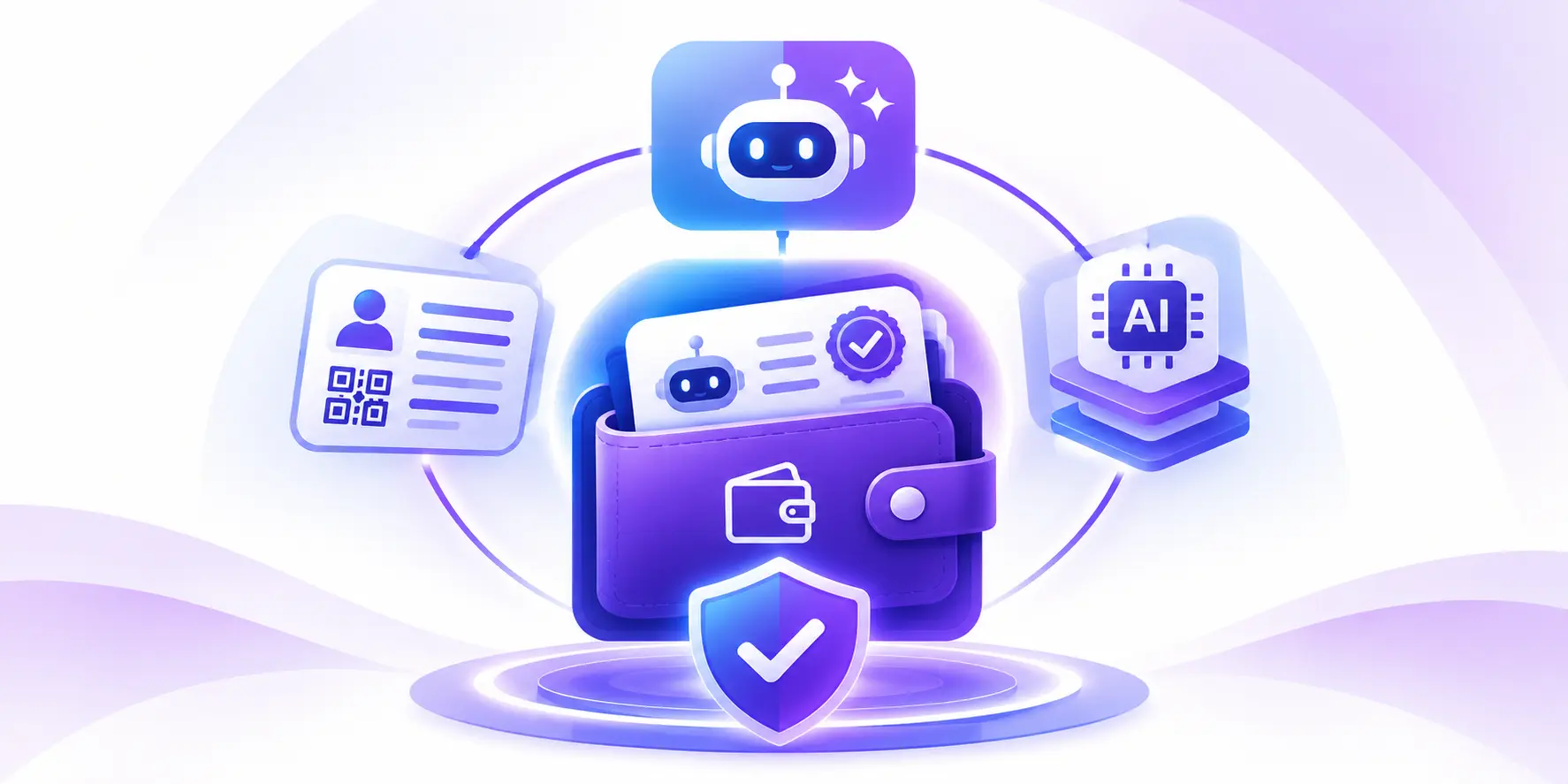
AI agents introduce a different challenge.
An autonomous agent may act on behalf of a human, interact with multiple applications, call external services and communicate with other agents across organisational boundaries. It needs more than an identifier. It needs a way to establish who it is, who is responsible for it, what it is authorised to do and under whose authority it is acting.
This creates an opportunity to rethink machine identity around Verifiable Credentials (VCs) and digital wallets.
The question is no longer simply whether an agent has a credential.
It is whether an agent can carry verifiable evidence of its identity, ownership, capabilities and delegated authority.
Key Takeaways
- Traditional machine identity models were not designed specifically for autonomous agents operating across organisational boundaries.
- Verifiable Credentials can provide cryptographically verifiable claims about an AI agent.
- Digital wallets can give agents a controlled mechanism for holding and presenting those credentials.
- Credentials can represent identity, ownership, capabilities and delegated authority.
- VC-based identity does not replace authorisation. It provides trusted information that can become an input to policy.
- Credential lifecycle, revocation, wallet security and delegated authority remain critical enterprise IAM concerns.
- The most practical model is likely to integrate VC and wallet capabilities with existing IAM, policy and runtime authorisation infrastructure.
The Machine Identity Problem Is Becoming More Complex
A traditional service account generally represents a system or application.
An API key identifies a client.
A workload identity establishes the identity of a workload.
These models assume relatively stable relationships between the identity, its owner and the resources it accesses.
AI agents make those relationships more dynamic.
An agent may be created for a specific business function, operate temporarily, receive authority from a human and interact with services that belong to another organisation.
The relying system may need to know:
- Who created or operates the agent?
- What is the agent's intended purpose?
- What capabilities has it been granted?
- Who delegated its authority?
- How long is that authority valid?
- Is the credential still valid?
- Is the requested action within its authorised scope?
A static identifier cannot answer all of these questions.
This is where Verifiable Credentials become relevant.
From Machine Credentials to Verifiable Claims
A Verifiable Credential provides a mechanism for an issuer to make claims about a subject that another party can cryptographically verify.
In an AI-agent environment, those claims could represent more than identity.
An enterprise could issue credentials that establish that an agent:
- Belongs to a particular organisation
- Is approved for a specific business purpose
- Has defined capabilities
- Has been delegated authority by a particular principal
- Is operating within a defined validity period
The relying party can verify the credential and then use the information as part of its own access decision.
This creates a more expressive identity model.
Instead of an agent simply presenting:
“I am Agent 7421.”
it can present verifiable evidence about what Agent 7421 represents and the authority associated with it.
The Role of a Digital Wallet
The wallet becomes the agent's identity and credential store.
It can hold the credentials and cryptographic keys required for the agent to establish its identity and present relevant claims to another system.
For autonomous agents, this creates an important distinction from traditional machine credentials.
The agent does not necessarily need one permanent credential that provides broad access.
Its wallet can contain different forms of identity evidence representing different relationships and capabilities.
For example, an agent may have an identity credential issued by its organisation and a separate credential representing delegated authority for a particular business function.
The relying system can request the information it needs and verify the relevant presentation.
This makes the wallet more than a storage mechanism.
It becomes part of the agent's identity boundary.
Identity Is Not Authorisation
One of the most important distinctions in this model is that a Verifiable Credential does not automatically grant access.
A credential can establish a claim.
The relying organisation still needs to determine whether the requested action is permitted.
An agent may hold a credential stating that it is an approved procurement agent.
That does not mean it should be allowed to approve every procurement transaction.
The policy engine may still evaluate:
- Transaction value
- Resource sensitivity
- Business context
- Delegated authority
- Time restrictions
- Existing policy
- Risk signals
The credential therefore becomes an input to authorisation rather than a replacement for it.
This distinction is essential if VC-based identity is to become part of an enterprise IAM strategy rather than another mechanism for distributing privilege.
Delegated Authority Becomes Critical
AI agents frequently operate on behalf of someone else.
That introduces delegation.
A human may authorise an agent to perform a specific task. The agent may then interact with another application or, eventually, another agent.
The identity chain becomes:
Human → Agent → Application
or potentially:
Human → Agent → Agent → Application
Each relationship needs to be governed.
The receiving system should be able to determine whether the agent is actually acting within the authority delegated to it.
This is where verifiable claims could provide significant value.
Instead of relying entirely on an internal database or pre-established trust relationship, an agent can present evidence of delegated authority that can be independently verified.
The policy engine can then determine whether that delegation is sufficient for the requested action.
Agent-to-Agent Trust
The value becomes even more apparent when agents interact across organisational boundaries.
Imagine an enterprise procurement agent communicating with a supplier's AI agent.
The supplier's agent cannot simply rely on the customer's internal directory.
It needs a portable way to establish trust.
A verifiable credential can provide evidence about the requesting agent, its organisation, its capabilities or its delegated authority.
The receiving system can verify the claims and apply its own policy before accepting the request.
This creates the possibility of a more interoperable machine identity layer for agent-to-agent interactions.
The critical shift is from pre-configured trust to verifiable trust.
Where Existing IAM Still Matters
VCs and wallets should not be viewed as a replacement for enterprise IAM.
They address a different part of the problem.
IAM remains responsible for identity lifecycle, governance, access policy and enterprise controls.
Policy engines remain responsible for evaluating whether a requested action is permitted.
Runtime security controls remain responsible for enforcing the decision.
VCs add verifiable identity and authority claims.
Wallets provide a mechanism for agents to hold and present those claims.
The resulting model is therefore complementary rather than disruptive.
This is particularly important for organisations that already have mature IAM and non-human identity programmes.
The objective should be to extend those programmes to autonomous identities rather than create a completely separate identity ecosystem for AI agents.
The Hardest Problem May Be Credential Lifecycle
Portability introduces a fundamental governance challenge.
What happens when an agent's authority changes?
An agent may receive permission to perform a function today and lose that permission tomorrow.
If the agent continues to hold a valid credential, the relying party needs a mechanism to determine whether that credential remains trustworthy.
Credential expiration, revocation and status checking therefore become critical.
The same applies to the wallet itself.
If an agent's private keys or wallet are compromised, the organisation needs to be able to disable the associated identity and credentials quickly.
For enterprise deployments, VC-based machine identity must therefore be connected to existing identity lifecycle and security operations processes.
Issuance alone is not enough.
The enterprise needs the ability to issue, monitor, suspend, revoke, rotate and retire agent identity.
The Strategic Potential of Agent Wallets
The larger opportunity is not simply giving AI agents another place to store credentials.
It is creating a portable identity layer that can travel with an autonomous entity while remaining governed by enterprise policy.
An agent could carry evidence representing:
Identity
Who the agent is.
Ownership
Which organisation is responsible for it.
Purpose
What the agent was created to do.
Capability
What functions it is permitted to perform.
Delegation
Whose authority it is operating under.
Validity
Whether those claims remain current.
This is considerably richer than today's conventional machine identity model.
It also aligns more closely with how autonomous systems actually operate.
The Trevonix Perspective
At Trevonix, we see Verifiable Credentials and digital wallets as potential building blocks for the next evolution of non-human identity.
AI agents will increasingly operate outside the boundaries of a single application or enterprise. They will interact with external platforms, APIs and other autonomous systems.
In that environment, machine identity needs to communicate more than a static identifier.
It needs to communicate trusted context.
VCs can provide verifiable claims.
Wallets can provide controlled custody and presentation.
IAM can manage lifecycle and governance.
Policy engines can determine authority.
Runtime controls can enforce the resulting decision.
The opportunity is therefore not to replace IAM with decentralised identity.
It is to extend IAM so that identity and authority can remain verifiable even when an agent crosses an organisational or trust boundary.
For enterprises, this distinction will become increasingly important as autonomous agents move from isolated assistants to participants in business processes.
Conclusion
The rise of AI agents is forcing enterprises to rethink what machine identity actually means.
Service accounts, API keys and workload identities remain important, but they do not necessarily provide the full context required when autonomous agents operate across systems and organisations.
Verifiable Credentials and digital wallets offer a potential foundation for a more portable identity model.
They can allow agents to carry verifiable evidence about who they are, who operates them, what capabilities they possess and what authority has been delegated to them.
But credentials alone are not enough.
Identity must remain connected to governance, authorisation, lifecycle management and runtime enforcement.
The future machine identity model may therefore look less like a permanent credential attached to a workload and more like a portable, verifiable identity with controlled authority.
As autonomous agents become part of enterprise ecosystems, that shift could become one of the defining developments in non-human identity security.