.png)

Artificial Intelligence has advanced remarkably over the past few years. The industry has focused on building larger models, increasing computational power and improving reasoning capabilities. However, the next phase of AI evolution is unlikely to be defined by models that simply think harder. Instead, it will be driven by systems that know when additional reasoning is necessary and when a simpler approach will deliver the best outcome.
Increasingly, AI systems are asking follow up questions, identifying missing context and adapting their reasoning before responding. Rather than treating every request equally, they are learning to assess complexity, understand intent and apply only the level of intelligence required for the task.
This marks the rise of adaptive intelligence, where efficiency becomes just as important as capability.
From Raw Compute to Intelligent Reasoning
The first generation of generative AI approached every request in much the same way. Whether answering a straightforward question or solving a complex problem, models typically applied significant computational effort to generate the most comprehensive response possible.
Today's AI systems are becoming far more context aware. Before generating an answer, they can evaluate the user's intent, determine whether additional information is needed and select the most appropriate reasoning strategy. In many cases, asking a clarifying question or choosing a lighter model produces a faster, more accurate and more efficient outcome.
This evolution is not about reducing intelligence. It is about applying intelligence more effectively.
Why Compute Efficiency Matters
As organisations integrate AI across business operations, efficiency is becoming a strategic priority.
Advanced AI models require significant computational resources, and applying the same level of processing to every request is neither practical nor economically sustainable. Enterprise AI platforms will increasingly need to balance performance with operational cost.
Adaptive intelligence addresses this challenge by allowing AI to allocate resources dynamically. Simple requests can be handled with lightweight models, while more complex tasks can be escalated to advanced reasoning models or specialised AI agents. The result is lower infrastructure costs, faster response times and a more scalable AI architecture.
Much like cloud computing drove the adoption of FinOps, enterprise AI is likely to introduce new disciplines focused on optimising compute usage without compromising capability.
The Evolution Towards Adaptive Autonomy
The next generation of AI will move beyond answering questions. AI agents will retrieve information, execute workflows, interact with enterprise applications and make operational decisions with minimal human intervention.
As AI becomes more autonomous, organisations must ask a different question. If an AI system can decide how much reasoning a task requires, should it also determine how much authority it needs to complete that task?
This introduces the concept of adaptive privilege.
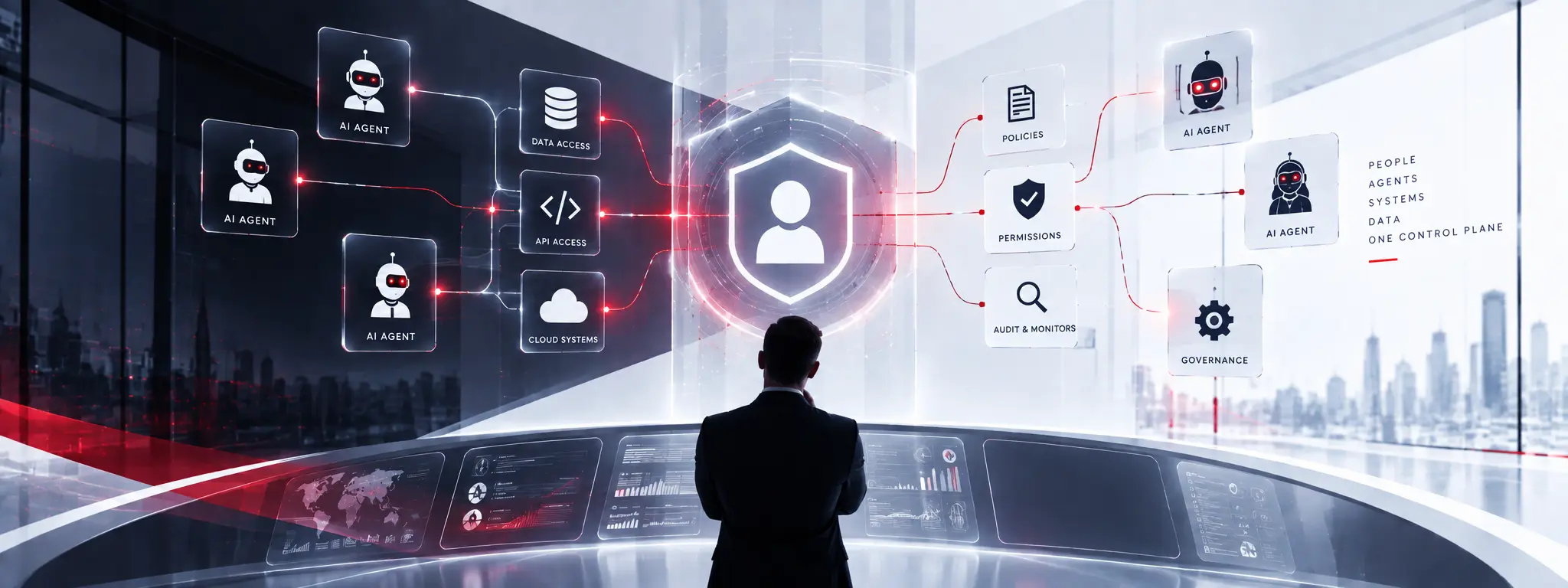
Rather than granting AI broad or permanent access to enterprise systems, future architectures are likely to provide AI agents with only the permissions required for a specific task. Access can be granted dynamically, continuously verified and revoked once the activity is complete.
This approach aligns naturally with Zero Trust principles, enabling organisations to reduce risk while supporting increasingly autonomous AI.
Identity Will Define Trusted AI
As AI agents become active participants in enterprise environments, identity will become fundamental to AI governance.
Organisations must know which AI agent initiated an action, what information it accessed and whether those actions complied with organisational policies. Identity governance, policy based access controls and continuous verification will provide the visibility and accountability required to deploy AI responsibly.
In this context, identity is no longer just about authenticating users. It becomes the foundation for trusted, secure and auditable AI systems.
Looking Ahead
The future of enterprise AI will not be defined solely by larger models or greater computational power. It will be shaped by systems that understand context, adapt their reasoning and use computational resources intelligently.
Adaptive intelligence represents a significant step in that evolution. By combining efficient reasoning with strong governance, identity controls and security, organisations can build AI systems that are more scalable, more cost effective and better aligned with enterprise requirements.
Final Thoughts
Adaptive intelligence represents more than another milestone in AI development. It reflects a broader shift towards systems that can reason efficiently, act responsibly and operate within clearly defined boundaries.
As enterprises move towards autonomous AI, the competitive advantage will not come from building systems that perform the most computation. It will come from building AI that knows exactly what it should do, when it should do it and how much authority it truly needs.
The future of enterprise AI belongs to systems that are not only intelligent, but also economically efficient, context aware and identity driven. Adaptive intelligence is not about doing less. It is about doing exactly what is needed, at exactly the right time.