
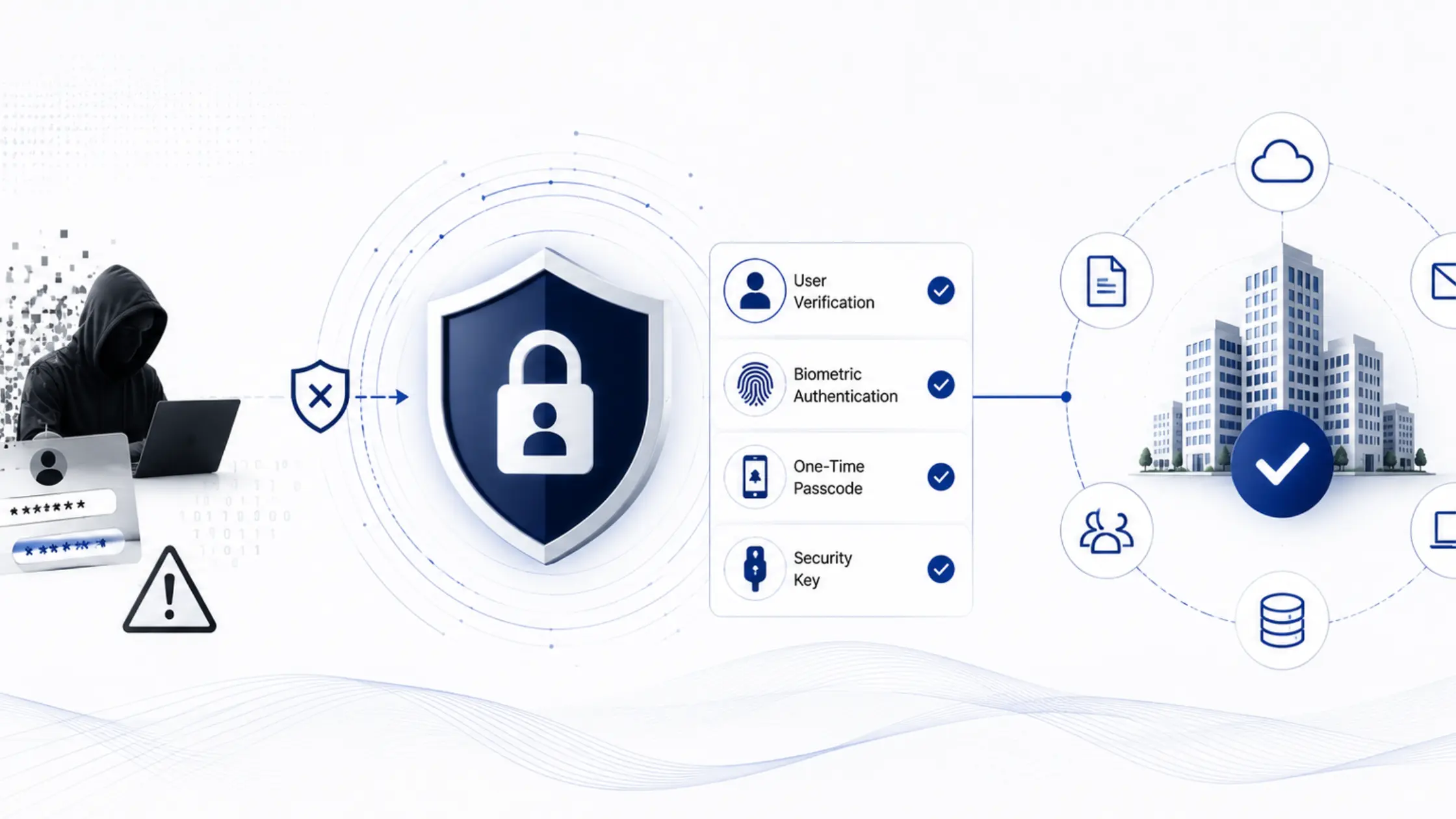
Modern Authentication has emerged as the preferred approach for securing enterprise identities. Instead of depending on passwords alone, it combines intelligent authentication methods, contextual access decisions, and stronger identity verification to reduce the risk of credential theft and account compromise.
In this guide, we'll explore how Modern Authentication protects organisations against credential-based attacks, why traditional authentication methods fail, and how businesses can strengthen their identity security strategy.
Table of Contents
- What Is Modern Authentication?
- Understanding Credential-Based Attacks
- How Modern Authentication Prevents Credential-Based Attacks
- The Role of Modern Authentication in Zero Trust Security
- Business Benefits of Modern Authentication
- Modern Authentication Best Practices for Enterprises
- How Trevonix Helps Enterprises Modernise Authentication
- Conclusion
What Is Modern Authentication?
Defining Modern Authentication
Modern Authentication is an identity verification approach that uses multiple intelligent security controls to verify users before granting access to enterprise applications and data. Rather than relying solely on passwords, it incorporates contextual information, device trust, biometric authentication, and additional verification methods to strengthen security.
Unlike legacy authentication systems, Modern Authentication continuously evaluates user identity throughout a session, making it significantly more effective at preventing unauthorised access.
Key Components of Modern Authentication
A comprehensive Modern Authentication strategy typically includes:
- Multi-Factor Authentication (MFA)
- Passwordless authentication
- Adaptive authentication
- Single Sign-On (SSO)
- Conditional access policies
- Risk-based access decisions
- Continuous identity verification
These technologies work together to create a secure yet seamless login experience for employees.
Understanding Credential-Based Attacks
Common Types of Credential Attacks
Credential-based attacks exploit stolen or weak login credentials to gain unauthorised access. Common attack methods include:
- Credential stuffing
- Password spraying
- Phishing attacks
- Brute-force attacks
- Keylogging malware
- Social engineering
Since many employees reuse passwords across multiple services, attackers can often compromise several business applications using a single stolen credential.
Why Traditional Authentication Fails
Traditional username-and-password authentication creates a single point of failure. Passwords can be guessed, stolen, reused, or leaked in data breaches.
Without additional verification mechanisms, organisations struggle to detect suspicious login attempts from unfamiliar devices, unusual locations, or impossible travel scenarios.
This is why organisations worldwide are replacing legacy authentication with Modern Authentication solutions that verify identity using multiple contextual signals.
How Modern Authentication Prevents Credential-Based Attacks
Passwordless Authentication Eliminates Password Risks
Passwords remain the weakest link in enterprise security.
Modern Authentication supports passwordless login methods such as:
- Biometrics
- Security keys
- Mobile authenticators
- Passkeys
By removing passwords from the authentication process, organisations significantly reduce phishing, password theft, and credential reuse attacks.
Passwordless authentication also improves employee productivity by reducing password reset requests.
Adaptive Authentication Detects Suspicious Behaviour
Adaptive authentication continuously evaluates login risk based on factors such as:
- User location
- Device health
- Login time
- IP reputation
- User behaviour
If unusual activity is detected, additional verification is automatically required.
This intelligent capability allows Modern Authentication to stop compromised accounts before attackers gain access.
Multi-Factor Authentication Adds Layers of Security
Even if attackers steal a password, Multi-Factor Authentication requires additional identity verification before access is granted.
Authentication factors may include:
- Something users know
- Something users have
- Something users are
By combining multiple verification methods, Modern Authentication dramatically reduces the likelihood of successful credential-based attacks.
Single Sign-On Improves Security and User Experience
Single Sign-On enables employees to securely access multiple business applications using one authenticated identity.
Rather than managing numerous passwords, users authenticate once through a trusted identity provider.
Combined with Modern Authentication, Single Sign-On reduces password fatigue while giving IT teams greater visibility and control over user access.
The Role of Modern Authentication in Zero Trust Security
Never Trust, Always Verify
Zero Trust assumes no user or device should be automatically trusted.
Instead, every access request must be verified continuously.
Modern Authentication plays a central role in Zero Trust by validating identity, device posture, and contextual risk before granting access.
Continuous authentication ensures security even after login.
Least Privilege Access
Zero Trust also enforces least privilege principles.
Employees receive only the minimum permissions required for their roles.
When integrated with Modern Authentication, organisations can dynamically adjust access permissions based on user risk, reducing opportunities for attackers to move laterally across enterprise systems.
Business Benefits of Modern Authentication
Implementing Modern Authentication provides numerous operational and security advantages:
- Reduces credential theft and phishing attacks
- Strengthens identity security across cloud applications
- Improves employee productivity with seamless access
- Supports hybrid and remote workforces
- Simplifies compliance with industry regulations
- Lowers IT support costs through passwordless authentication
- Enhances user experience without compromising security
- Enables scalable identity protection for growing organisations
These benefits make Modern Authentication an essential investment for modern enterprises.
Modern Authentication Best Practices for Enterprises
To maximise the effectiveness of Modern Authentication, organisations should:
- Deploy passwordless authentication wherever possible.
- Enforce Multi-Factor Authentication for all users.
- Implement adaptive authentication with risk-based policies.
- Use Single Sign-On to centralise identity management.
- Continuously monitor user behaviour and login activity.
- Apply least privilege access controls.
- Regularly review authentication policies.
- Educate employees about phishing and credential theft.
A layered identity security strategy significantly improves resilience against evolving cyber threats.
How Trevonix Helps Enterprises Modernise Authentication
Trevonix helps organisations implement secure, scalable identity security solutions that protect users without creating unnecessary friction.
Through its Workforce Identity & Access Management solutions, Trevonix enables organisations to deploy Modern Authentication, passwordless authentication, Multi-Factor Authentication, adaptive authentication, Single Sign-On, and intelligent access policies tailored to business needs.
By combining advanced identity protection with seamless user experiences, Trevonix helps enterprises reduce credential-based attacks, strengthen Zero Trust security, and simplify identity management across cloud, hybrid, and on-premises environments.
Conclusion
Credential-based attacks continue to be one of the biggest cybersecurity threats facing modern organisations. Traditional password-only security is no longer capable of protecting today's distributed workforce and cloud-based applications.
Modern Authentication provides a stronger, more intelligent approach by combining passwordless authentication, adaptive authentication, Multi-Factor Authentication, and Single Sign-On to verify identities with greater confidence.
As businesses continue their digital transformation, adopting Modern Authentication is no longer optional—it's a critical step towards building a resilient Zero Trust security strategy that protects enterprise identities, sensitive data, and business operations from increasingly sophisticated cyber threats.