
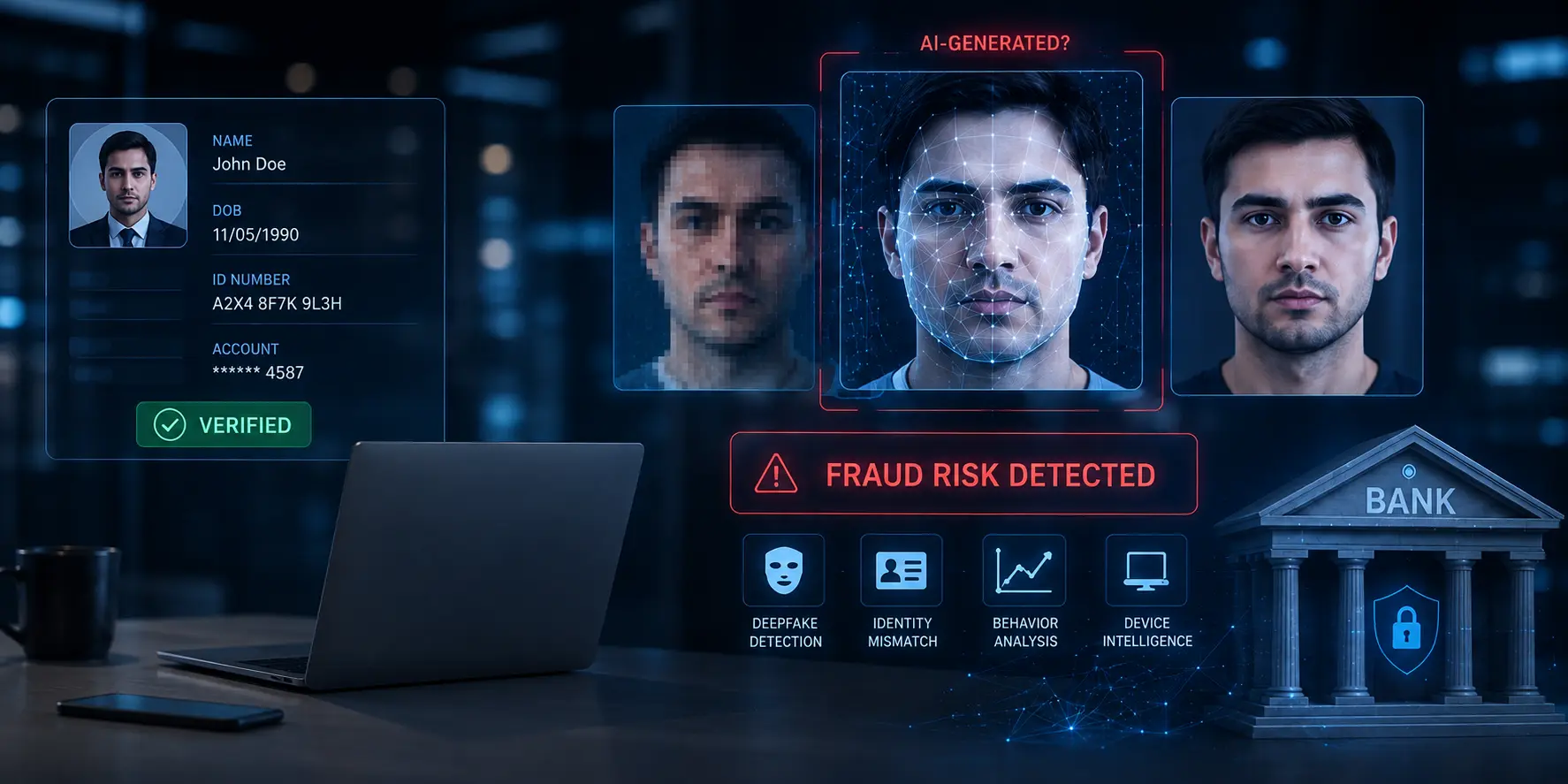
What once required advanced hacking skills can now be done with publicly available AI tools. Fraudsters can clone voices, generate realistic faces, and create entire digital identities that appear legitimate. This shift is putting immense pressure on fraud detection in banking, forcing institutions to rethink how they verify identity and prevent unauthorised access.
In this blog, we’ll explore how deepfakes and AI generated personas are reshaping modern financial threats, why traditional fraud detection systems are struggling, and what banks must do to strengthen fraud prevention in an AI-driven world.
Table of Contents
- Understanding Deepfakes in the Context of Banking Fraud
- What Are AI-Generated Personas?
- The Evolution of Fraud Detection in Banking
- How Deepfakes Are Being Used in Financial Fraud
- AI-Generated Personas and Synthetic Identity Fraud
- Why Traditional Fraud Detection Methods Are Struggling
- The Impact of Deepfakes on Fraud Detection in Banking Systems
- Key Technologies Used for Modern Fraud Detection
- The Role of Artificial Intelligence in Fraud Detection and Fraud Prevention
- Identity Verification Challenges in the Age of Deepfakes
- Strategies Banks Are Using for Fraud Prevention
- Regulatory and Compliance Implications for Fraud Detection in Banking
- Best Practices for Strengthening Fraud Detection Against AI-Driven Fraud
- The Future of Fraud Detection in Banking
- Conclusion
Understanding Deepfakes in the Context of Banking Fraud
Deepfakes are AI-generated media—videos, images, or audio—that convincingly mimic real people. In banking, they are increasingly used to impersonate customers, executives, or even customer support agents.
For example:
- A fraudster can use a deepfake voice to authorise a transaction
- A fake video identity can bypass KYC verification
- AI-generated faces can be used to open fraudulent accounts
This growing use of deepfakes is making fraud detection in banking far more complex than before. Traditional systems were built to detect anomalies—not hyper-realistic simulations of real users.
What Are AI-Generated Personas?
AI generated personas are fully fabricated digital identities created using artificial intelligence. These personas often combine:
- Fake names and addresses
- Synthetic facial images
- Generated behavioral patterns
Unlike traditional identity theft, where real data is stolen, these personas are built from scratch—making them harder to trace.
In many cases, AI generated personas are used to:
- Open bank accounts
- Apply for loans
- Conduct long-term financial fraud
This rise in synthetic identities is one of the biggest challenges facing fraud detection in banking today.
The Evolution of Fraud Detection in Banking
Fraud detection has evolved significantly over the years:
1. Rule-Based Systems
Early systems relied on predefined rules:
- Flagging large transactions
- Detecting unusual locations
2. Behavior-Based Monitoring
Banks began analysing:
- Spending patterns
- Login behavior
3. AI-Driven Fraud Detection
Modern systems use machine learning to:
- Detect anomalies
- Predict potential fraud
However, with the rise of deepfakes and AI generated personas, even advanced fraud detection systems are being challenged.
How Deepfakes Are Being Used in Financial Fraud
Fraudsters are leveraging deepfakes in increasingly creative ways:
- Voice Phishing (Vishing): Cloned voices of executives to authorise payments
- Video KYC Bypass: Fake videos used to pass identity verification
- Social Engineering: Deepfake personas used in video calls
These methods are highly effective because they exploit human trust. As a result, fraud detection in banking must now go beyond data analysis and address psychological manipulation.
AI-Generated Personas and Synthetic Identity Fraud
Synthetic identity fraud is driven largely by AI generated personas.
Here’s how it works:
- Create a fake identity using AI
- Build a financial history over time
- Apply for credit or loans
- Disappear after extracting funds
Because these identities are not tied to real individuals, they are difficult to detect. This makes fraud prevention significantly more challenging.
Banks are now seeing a surge in such cases, forcing them to upgrade their fraud detection strategies.
Why Traditional Fraud Detection Methods Are Struggling
Traditional systems are failing for several reasons:
- They rely heavily on historical data
- They are not designed to detect synthetic identities
- They cannot analyse deepfake media effectively
For instance, a perfectly generated AI face may pass facial recognition checks. Similarly, a cloned voice can bypass call-based verification systems.
This gap is why fraud detection in banking must evolve rapidly.
The Impact of Deepfakes on Fraud Detection in Banking Systems
The rise of deepfakes is fundamentally changing how banks approach security.
Key impacts include:
- Increased false positives and false negatives
- Higher operational costs
- Reduced customer trust
Banks must now invest in advanced tools that can detect subtle inconsistencies in AI-generated content.
Without this, fraud detection in banking risks becoming reactive rather than proactive.
Key Technologies Used for Modern Fraud Detection
To combat evolving threats, banks are adopting advanced technologies:
- Biometric Authentication
- Behavioral Analytics
- Device Fingerprinting
- AI-Based Risk Scoring
These technologies enhance fraud detection by analysing multiple layers of data.
However, they must continuously evolve to counter AI generated personas and deepfakes.
The Role of Artificial Intelligence in Fraud Detection and Fraud Prevention
Artificial intelligence is both the problem and the solution.
On one hand:
- It enables deepfakes and synthetic identities
On the other:
- It powers advanced fraud detection systems
AI helps banks:
- Detect anomalies in real time
- Analyse behavioral patterns
- Predict potential fraud
This dual role makes AI central to modern fraud prevention strategies.
Identity Verification Challenges in the Age of Deepfakes
Identity verification is becoming increasingly complex due to:
- Hyper-realistic fake images
- Voice cloning technologies
- Synthetic identity creation
Banks must now verify:
- Who the user is
- Whether the identity is real
- Whether the behavior matches
This makes fraud detection in banking more layered and dynamic than ever.
Strategies Banks Are Using for Fraud Prevention
Banks are adopting several strategies to strengthen fraud prevention:
- Multi-factor authentication (MFA)
- Continuous authentication
- Risk-based access control
- Real-time monitoring
They are also investing in AI systems that can detect deepfakes and identify AI generated personas more effectively.
Regulatory and Compliance Implications for Fraud Detection in Banking
Regulators are increasingly focusing on:
- Data protection
- Identity verification
- Fraud reporting
Banks must comply with regulations such as:
- KYC (Know Your Customer)
- AML (Anti-Money Laundering)
Failure to adapt can lead to penalties and reputational damage.
This makes robust fraud detection in banking not just a security requirement, but a compliance necessity.
Best Practices for Strengthening Fraud Detection Against AI-Driven Fraud
To stay ahead, banks should:
- Invest in AI-powered detection tools
- Implement layered security models
- Continuously update verification systems
- Train employees on emerging threats
These practices improve both fraud detection and fraud prevention in the long run.
The Future of Fraud Detection in Banking
The future will be defined by:
- AI vs AI security battles
- Advanced biometric systems
- Decentralised identity frameworks
As deepfakes become more sophisticated, banks must adopt proactive and adaptive strategies.
The focus will shift from detection to prevention—stopping fraud before it happens.
Conclusion
The rise of deepfakes and AI generated personas marks a turning point in the evolution of financial threats. These technologies are not just enhancing fraud tactics—they are redefining the entire landscape of fraud detection in banking.
To stay secure, banks must move beyond traditional systems and embrace AI-driven, identity-first security approaches. Strong fraud prevention strategies, continuous monitoring, and advanced identity verification will be key to combating next-generation threats.
Organisations looking to strengthen their fraud detection capabilities can benefit from working with experts in identity and access management. Trevonix, a global company headquartered in London, specializes in building secure, scalable solutions that help financial institutions defend against modern AI-driven fraud.
In an era where identities can be fabricated and trust can be manipulated, the future of fraud detection in banking depends on one critical factor: the ability to verify not just who someone claims to be—but whether they are real at all.