

While much of the risk centers on ASA/FTD WebVPN (HTTPS) endpoints, other web services on ASA/FTD could also be targeted (e.g. management interfaces). Be sure to inventory all web-facing functions.
Table of Contents
What’s Going On - The Big Picture
- Cisco has confirmed two zero-days—CVE-2025-20333 and CVE-2025-20362—are being exploited in the wild.
- A third vulnerability, CVE-2025-20363, though not yet confirmed in active exploitation, is considered high risk and was also patched by Cisco as a precaution.
- The U.S. Cybersecurity and Infrastructure Security Agency (CISA) issued Emergency Directive 25-03, mandating federal agencies to take immediate action to identify and mitigate potential compromises on Cisco ASA/FTD systems.
- Shadowserver Foundation, among others, is tracking tens of thousands of internet-facing ASA/FTD devices still exposed and unpatched.
In short: this is not a theoretical risk. Attackers are already exploiting these flaws, and many devices remain vulnerable.
Technical Breakdown: The Vulnerabilities, Malware, and Attack Chain
The Vulnerabilities
Here’s a summary of the three disclosed flaws:
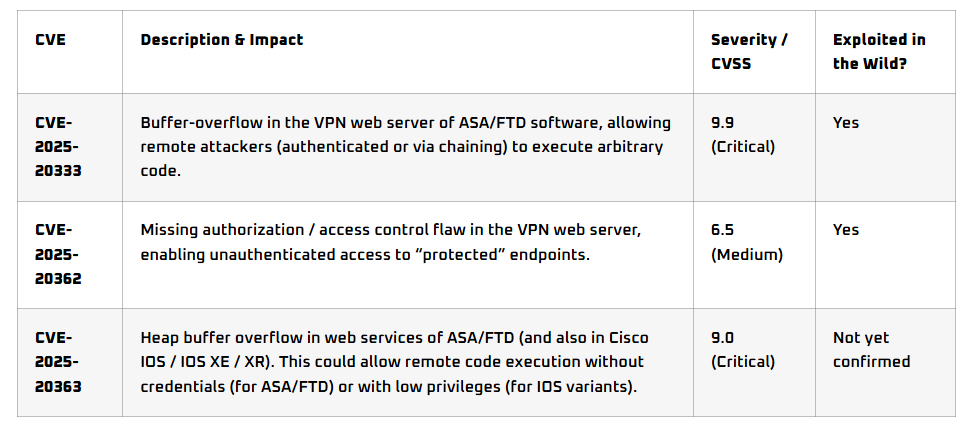
Notably, Cisco and other threat intelligence groups observe that CVE-2025-20333 and CVE-2025-20362 can be chained: an attacker might exploit the missing authorization flaw (CVE-20362) to reach otherwise protected surfaces, then trigger the buffer overflow (CVE-20333).
Malware, Persistence, and Evasion
The campaign is not merely about initial compromise — attackers are deploying highly sophisticated, stealthy implants to maintain long-term control and resist detection:
- RayInitiator: A multi-stage bootkit that alters the GRUB bootloader and firmware-level components, enabling persistence even across reboots or software updates.
- LINE VIPER: A modular shellcode loader that works in user memory (after boot) to execute commands, tamper configurations, disable logging, and exfiltrate data. It can communicate over HTTPS WebVPN sessions or via ICMP covert channels.
Attackers are also employing anti-forensic techniques, including:
- Disabling or intercepting logging and diagnostics, to hide traces of exploitation.
- Triggering intentional device crashes to hamper forensic collection.
- Intercepting CLI commands or output to mislead or suppress indicators.
These tactics strongly suggest a nation-state or highly resourced threat actor, not opportunistic script kiddies. Indeed, public reporting links the actor to UAT4356 / STORM-1849, tied to the prior “ArcaneDoor” espionage campaigns.
Scope, Exposure & Real-World Numbers
- Shadowserver’s scanning shows nearly 48,000–50,000 unpatched ASA/FTD devices exposed on the internet.
- The United States alone accounts for over 19,000 exposed devices; other hotspots include the UK and Germany.
- Many vulnerable devices are older ASA 5500-X series appliances, particularly those nearing or past their end-of-support (EoS) dates and lacking secure boot protections.
- Cisco and supporting security agencies noted that scanning activity targeting ASA/FTD began weeks before the public disclosure, strongly indicating advanced reconnaissance by the attacker.
These data points point to a massive and urgent problem: a large base of devices that serve as network perimeter gateways remain unprotected and vulnerable to infiltration.
Impact & Risks of Compromise
Compromised ASA/FTD devices constitute a high-value intrusion vector. Some of the risks include:
- Full control over firewall / VPN gateway: Attackers can manipulate access rules, reroute traffic, or bypass security controls.
- Stealthy network infiltration: With control at the perimeter, adversaries can stealthily pivot into internal segments.
- Data exfiltration and configuration breach: Access to logs, user credentials, network data, or stored secrets.
- Persistent implants: Via RayInitiator, attackers can survive reboots or firmware upgrades.
- Anti-forensics: Logging suppression or crashes will frustrate detection, attribution, or recovery.
- Supply chain or future exploit reuse: Compromised devices could be used as stepping stones or as part of lasting backdoor infrastructure.
Given the central role of firewalls/VPN gateways in network security posture, this is a threat that demands immediate attention.
What Organizations Must Do Now (Immediate Steps)
Here’s a prioritized, structured response roadmap for organizations that use Cisco ASA or FTD:
1. Inventory & exposure assessment
- Identify all ASA, ASAv, and FTD devices deployed (including cloud or remote appliances).
- List which ones are internet-facing, especially those exposing WebVPN / HTTP(S) interfaces.
- Check firmware and software versions against Cisco’s affected release lists.
2. Apply patches / updates immediately
- Cisco has released fixes for CVE-20333, CVE-20362, and CVE-20363.
- There are no documented workarounds; patching is the primary defense.
- For devices that will reach EoS imminently or already have, consider decommissioning or segmenting them off the network.
3. Threat hunting & forensic analysis
- Use instructions from CISA (Core Dump & Hunt guidance) to collect memory dumps, logs, and search for signs of compromise.
- Look specifically for indicators of RayInitiator, LINE VIPER, or traces of log suppression, CLI interception, or device crashes.
- If a device is suspected to be compromised, isolate (do not power off) and restore from known-good backups or factory defaults after clean-up.
4. Rekey & reconfigure
- After patching or clean restoration, reset passwords, keys, certificates, and configuration rather than reusing potentially tainted elements.
- Rebuild device configuration from scratch where possible.
5. Restrict access, enhance monitoring
- If possible, restrict or block WebVPN (HTTPS) interfaces to trusted IP addresses or internal management zones until fully mitigated.
- Increase logging, monitoring, and alerting for anomalous VPN sessions, unauthorized URL access, or abnormal CLI commands.
- Use Intrusion Detection / Prevention or network segmentation to detect suspicious traffic near firewall endpoints.
6. Report to authorities / agencies
- In many regions, critical infrastructure owners may have regulatory or legal obligations to report.
- U.S. federal entities specifically must follow CISA’s directive.
7. Ongoing vigilance & update discipline
- Update devices within 48 hours after any new security patch availability as recommended by Cisco.
- Audit the firewall/VPN fleet periodically to identify new exposures.
- Consider deploying compensating controls (e.g., Web Application Firewall in front of WebVPN endpoints) to reduce direct exposure.
Why This Attack Campaign Is Noteworthy
Edge devices as prime targets:
Firewalls, VPN gateways, and perimeter appliances are gateway chokepoints. Compromising them gives attackers direct access to internal networks with minimal friction.
High sophistication:
The use of custom bootkits (RayInitiator), modular shellcode (LINE VIPER), and advanced evasion shows the hand of a powerful actor.
Persistence across reboots:
The fact that attackers aim for firmware-level persistence means even patched systems may not remove the implant unless cleaned thoroughly.
Precedence with ArcaneDoor:
This campaign mirrors and builds upon the earlier ArcaneDoor attacks which also compromised Cisco perimeter devices.
Large attack surface:
The vast number of internet-connected ASAs remaining unpatched means even less critical organizations may become collateral victims.
No easy fallback:
Because no effective mitigations exist outside patching, speed and discipline matter more than ever.
Conclusion:
The discovery of zero-day vulnerabilities in Cisco ASA/FTD that are already being actively exploited represents one of the most serious firewall/VPN security incidents in recent memory. Because these devices form the frontline of network defense, a successful attack can render the rest of your security stack moot.
Source:
https://unit42.paloaltonetworks.com/zero-day-vulnerabilities-affect-cisco-software/
https://www.tenable.com/blog/cve-2025-20333-cve-2025-20362-faq-cisco-asa-ftd-zero-days-uat4356